

Compliance evidence that holds up continuously, not just at audit time
Auditors don't accept policies. They ask for proof that your controls worked, across the observation period, in the environments where your data actually lives.
Pentest-Tools.com generates the technical evidence your compliance program needs: validated findings, retest comparisons, and audit-ready exports that map cleanly to the frameworks you're held to.

Pick your framework. We'll show you the evidence chain it needs
DORA
Pentest-Tools.com supplies continuous ICT risk evidence for EU financial entities.
Article 25 expects rolling proof that your vulnerability management programme works across the year, not just on the day of the audit.
NIS2
Risk-management evidence for essential and important entities across 18+ sectors, including energy, healthcare and manufacturing.
Article 21 requires effectiveness assessments, vulnerability handling, and supplier security evidence that holds up to national authority scrutiny.
SOC 2
You can get type II evidence for CC7.1 through CC7.3 across the observation period with Pentest-Tools.com.
Auditors want validated findings, retest documentation, and monitoring records that span the full 6 or 12 months, not a single point-in-time test.
CRA
Vulnerability handling for products with digital elements placed on the EU market is an essential condition for doing business in this geography.
Starting September 2026, manufacturers must report actively exploited vulnerabilities within 24 hours and demonstrate continuous vulnerability handling across the product's support period.
ISO 27001
Vulnerability evidence across the three-year certification cycle is a must-have for ISO27001.
Specific annexes expect continuous technical evidence, not annual snapshots produced the week before each surveillance audit. Pentest-Tools.com helps with that.
The evidence problem
GRC platforms collect policies, control mappings, and the Statement of Applicability
They don't generate technical evidence. They need something to feed them, and most teams haven't built that pipeline.
Manual penetration tests give you a point-in-time snapshot
They're useful, but a single report doesn't cover 12 months of SOC 2 Type II operation, the rolling effectiveness assessments NIS2 expects, or the continuous ICT risk evidence DORA requires.
Automated scanners produce findings
They don't produce audit evidence. Auditors reject raw scan output that lacks validation, business context, or a remediation proof chain.
Compliance teams end up reformatting, manually verifying, and chasing remediation sign-off. That work shouldn't exist if teams use accurate vulnerability detection and validation sources.
The gap is between detection and evidence. It's a workflow problem, not a technology problem. Pentest-Tools.com closes it.

What audit-ready evidence actually looks like
Auditors and assessors ask for four things.
Strong tooling produces all four as a byproduct of the scan workflow, not as a separate reporting effort.

Proof
A finding has to show the vulnerability in action, not assert it exists. Screenshots of a successful exploit. HTTP request and response pairs. Payload traces. The artifact, not the CVE ID.

Reproducibility
Findings need enough detail that an engineer can recreate the issue and an auditor can verify it persists until remediation closes it. Exact endpoints, preserved request and response data, before-and-after screenshots after the retest.

Context
Technical classification, exploitability signal, and concrete business impact. A CVSS score alone doesn't tell the auditor whether the risk was accepted, transferred, or mitigated, or why one finding warranted an emergency patch and another didn't.


Get a guided product walkthrough with our experts
How Pentest-Tools.com produces audit-ready evidence
The four traits above map directly to specific product capabilities. The full evidence chain (scan, validate, remediate, retest, export) runs in the same product without manual handoffs.
Comprehensive, accurate vulnerability scanning
Pentest-Tools.com covers the full in-scope surface: web apps, APIs, networks, and cloud, externally and internally. Authenticated scans reach behind the login wall, and the VPN Agent extends scanning into private cloud and internal infrastructure that public scanners can't see.

Network Vulnerability Scanner
The Network Vulnerability Scanner combines four complementary engines and ranked #1 in last year’s benchmark for remote detection accuracy. It runs externally for internet-facing assets, and internally through the VPN Agent for private cloud, on-premises, and authenticated environments.

Website Vulnerability Scanner
The Website Vulnerability Scanner uses a built-in ML Classifier and proprietary payloads to test web apps and APIs, including paths behind the login wall. Findings get marked Confirmed only when evidence supports it, so the auditor sees validated proof, not raw detections.

Cloud Scanner, Sniper: Auto-Exploiter
The Cloud Scanner imports AWS assets directly for continuous monitoring of cloud infrastructure. Sniper: Auto-Exploiter runs simulated attacks and captures exploit traces, screenshots, and PoC artifacts.

Password Auditor
The Password Auditor demonstrated valid credential compromise in 84% of test cases. That's proof, not a flag.
Vulnerability validation and the evidence chain
The four-step evidence chain works the same way for every framework.
The scanner detects a vulnerability
It records its severity, CVE reference, asset context, and timestamp.
Pentest-Tools.com validates the vulnerability
Our product uses AI-enhanced capabilities to improve accuracy, backing confirmed vulnerabilities with HTTP request and response data or a PoC.
The team remediates it
A retest workflow follows, with a before-and-after comparison.
The fix held
Scheduled rescans and monitoring alerts for regression.
Vulnerability assessment reporting

Audit trails, automated
Scheduled scans generate DOCX, PDF, and HTML reports auto-filled with findings, summaries, and remediation advice. Scan diffs build a timestamped history of new, updated, and resolved findings, the kind of recurring evidence PCI DSS, ISO 27001, SOC 2, and other framework cycles ask for.
Pentest reporting

Real proof, confirmed
Pentest reports include an Executive Summary, Methodology, and Technical findings with full HTTP requests, command outputs, and attack replays. Sniper-validated findings carry a ‘Confirmed’ tag, so auditors and developers see proof, not raw detections. Editable DOCX for compliance teams, read-only PDF for the board.
Branded reports

Flexibility across the board
Branded reports carry your logo and corporate identity, and can be sent directly from your company domain. Useful for MSPs and consultants delivering reports across multiple clients.
Integrations for vulnerability management workflows

Smoother vulnerability detection, triage, and reporting
The integration layer is what keeps evidence in your team's existing workflow instead of in a separate spreadsheet. Findings sync to GRC and vulnerability management platforms (Vanta, Nucleus Security), push as tickets into ticketing and team-communication tools (Jira, Slack, Microsoft Teams, Discord), run on every pull request through CI/CD and cloud integrations (GitHub Actions, AWS), and flow through webhooks and the REST API when something custom is needed. Compliance signals reach the systems your team already runs in, not a separate queue.

See how Pentest-Tools.com supports your compliance process
Why our European origin matters for regulated buyers
For DORA, NIS2, and CRA buyers, where a security tool processes data is a procurement criteria, not a preference. Using an EU-based tool isn't legally mandated, but it bypasses a massive set of third-party compliance questions.

DORA requires financial entities to manage ICT 3rd-party risk, including where critical providers process data
Using a non-EU vulnerability scanning platform to assess EU financial infrastructure raises a procurement question your team has to address. EU processing removes it.
NIS2 extends supply-chain security obligations to suppliers of essential and important entities
Vendor due diligence under NIS2 increasingly asks where data goes, not just whether the vendor has ISO 27001. EU-resident processing answers that question cleanly.
The Cyber Resilience Act routes vulnerability reports directly to ENISA and EUVD
The Cyber Resilience Act mandates that vulnerability reports are channeled straight to ENISA, the European Union's specialized cyber security agency. This system integrates directly with the EU Vulnerability Database (EUVD), meaning that EU-based tooling and security infrastructure sit much closer to the pipeline operationally, streamline compliance, and speed up threat response times.
GDPR applies to almost every organization handling personal data in the EU
It requires appropriate technical and organizational measures to secure that data, including regular testing of those measures' effectiveness. Vulnerability scanning is one of the defensible technical measures regulated organizations document. The same evidence chain that supports DORA, NIS2, and CRA satisfies GDPR's testing requirement without separate effort.
Pentest-Tools.com is ISO/IEC 27001:2022 certified
The ISMS is independently audited, the controls are documented, and the improvement process is continuous. If you’re evaluating Pentest-Tools.com under DORA, NIS2, or GDPR, this is the credential that matters most in your specific context: scan results, findings, and reports stay in EU infrastructure throughout.
This isn't a claim about superiority. It's the structural reality of how regulated procurement works in 2026.
Built on actual proof, not claims
#1 in the Network Scanners Benchmark for remote detection accuracy
17,000+ CVEs covered
More than 6M scans run last year across 2,000+ security teams in 119 countries
ISO/IEC 27001 certified, data processed in the EU
The team behind the product
Pentest-Tools.com is built by a team of product, engineering, and security professionals, alongside an in-house services practice of offensive security specialists holding GSE, OSCP, GWAPT, GPEN, GXPN, OSWP, and CEH certifications. The detection capabilities within the product come from the same research practice that delivers our services engagements, so what the services team learns in the field shows up in the product.
The services team is also approved by the Romanian National Cybersecurity Directorate (DNSC), the Romanian competent authority for NIS2 transposition and the national CSIRT.

Validated by the industry. Trusted at scale.
#1 in the Network Scanners Benchmark for remote detection accuracy
17,000+ CVEs covered
More than 6M scans run last year across 2,000+ security teams in 119 countries
ISO/IEC 27001 certified, data processed in the EU
DNSC approved
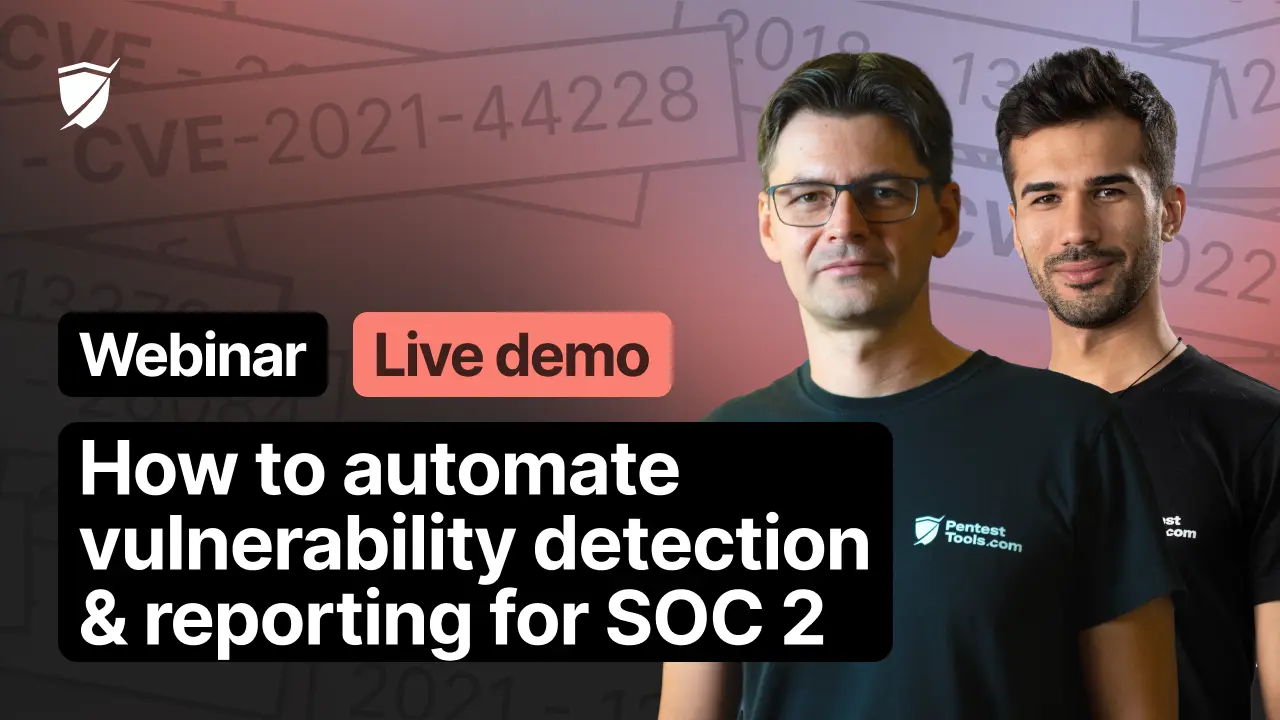
Ready to see it run against your environment?
Run the Website Vulnerability Scanner for free against an asset you own, see what comes back, and check the output against the evidence shape your auditor is asking for. The Free Edition is just a small sample of what Pentest-Tools.com produces, but it’s enough to recognise the difference between detected and validated findings, and decide whether the full product belongs in your stack.

Compliance FAQs
Does Pentest-Tools.com make us compliant with DORA, NIS2, SOC 2, or ISO 27001?
No tool produces compliance. Only auditors and regulators can award this certification. Pentest-Tools.com generates the technical evidence your compliance program needs: validated findings, remediation documentation, and audit-ready reports. How that evidence maps to your specific framework obligations depends on your GRC programme and your auditor.
What's the difference between Pentest-Tools.com and a GRC tool?
GRC tools such as Vanta or Sprinto track that controls exist and map them to framework requirements. They need evidence fed into them, but they don't generate it.
Pentest-Tools.com is the technical layer that produces the evidence you need. The outputs (validated findings with exploitability proof, audit-ready reports in PDF, DOCX, or JSON, and a continuous scan history with retest evidence) flow into your GRC platform through Vanta sync, Jira, JSON export, or webhooks.
What does "audit-ready evidence" mean in practice?
Auditors ask for four things: proof a vulnerability existed (scan result with timestamp and CVE reference), proof it was validated (confirmed finding with exploit trace or request and response evidence), proof it was remediated (retest with before-and-after comparison), and proof the fix held (scheduled rescan showing the issue doesn't reappear).
Pentest-Tools.com produces all four as a by-product of the scanning and monitoring workflow, not as a separate reporting task.
Does the platform work for EU-regulated organisations under DORA, NIS2, CRA, and GDPR?
Yes. Pentest-Tools.com is ISO/IEC 27001:2022 certified and processes data in the EU. For financial entities under DORA, essential and important entities under NIS2, manufacturers under CRA scope, and organisations meeting GDPR Article 32 testing obligations, EU data processing is a relevant procurement consideration.