

AI pentesting in 2026: why testing cadence decides who copes
We surveyed 158 security practitioners about how AI is reshaping penetration testing vulnerability discovery, and why validation is now the skill that separates teams that keep up from teams that get buried.
88% of practitioners encounter results that need significant manual validation
63% rank false positive rate above cost when evaluating AI pentesting software
1 in 4 practitioners reworks more than 25% of the findings AI tools produce

The numbers
37.3% say stakeholders now demand more frequent testing than 12 months ago
41% are most concerned by the gap between vulnerability disclosure and patching
Only 20.3% have a workflow to triage high volumes of AI-generated findings
49.4% test AI systems only when a stakeholder specifically requests it
Why we ran this survey
Security practitioners sit between two conversations that rarely meet: they use AI to find and report vulnerabilities faster, and they secure the AI systems their organizations deploy.
Both conversations are accelerating at once, and the people running security testing feel the pressure from each side.
Most published research covering this shift focuses on security leaders and buyers. We wanted to hear from the people who do the testing.
In June 2026, Pentest-Tools.com surveyed 158 security practitioners
All of them use AI-assisted tools in their vulnerability assessment and validation work (including pentesting): penetration testers, security engineers, DevSecOps professionals, and appsec professionals.
The results show how AI is changing the way practitioners discover, validate, and prioritize vulnerabilities
The pattern is highly consistent: practitioners trust AI output only as far as they can verify it, and verification is where the pressure now concentrates.

Practitioners use AI most where mistakes are cheapest to catch
Before the frustrations, the baseline: AI is already embedded in most phases of the pentest engagement, but very unevenly.
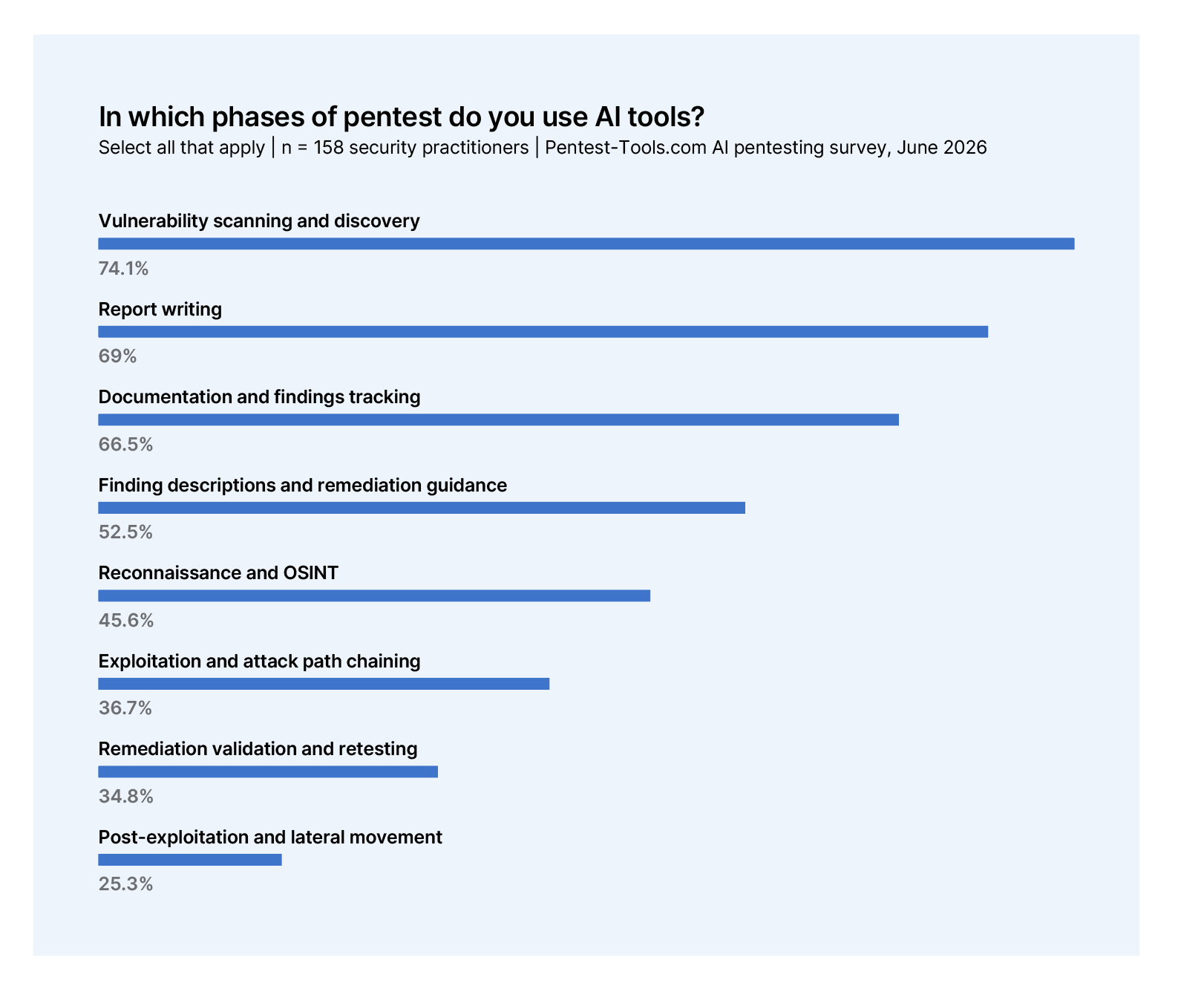

Practitioners use AI tools most for vulnerability scanning and discovery (74.1%) and for the writing that follows:
→ To write reports (69%),
→ To document and track findings (66.5%),
→ To improve finding descriptions with remediation guidance (52.5%).
AI usage drops sharply in the phases of a pentest that require live judgment:
→ exploitation and attack path chaining (36.7%),
→ remediation validation and retesting (34.8%),
→ post-exploitation (25.3%).
AI excels at report quality, not high-risk execution phases
When we asked security practitioners where AI pentesting tools currently perform best, they put report quality and developer-readiness first, at 62%. Accurate risk rating follows at 43.7%, with exploit validation and proof of concept at 37.3%.
The pattern in both questions is the same: practitioners have placed AI where errors are cheap to catch and kept it out of the phases where errors are expensive.
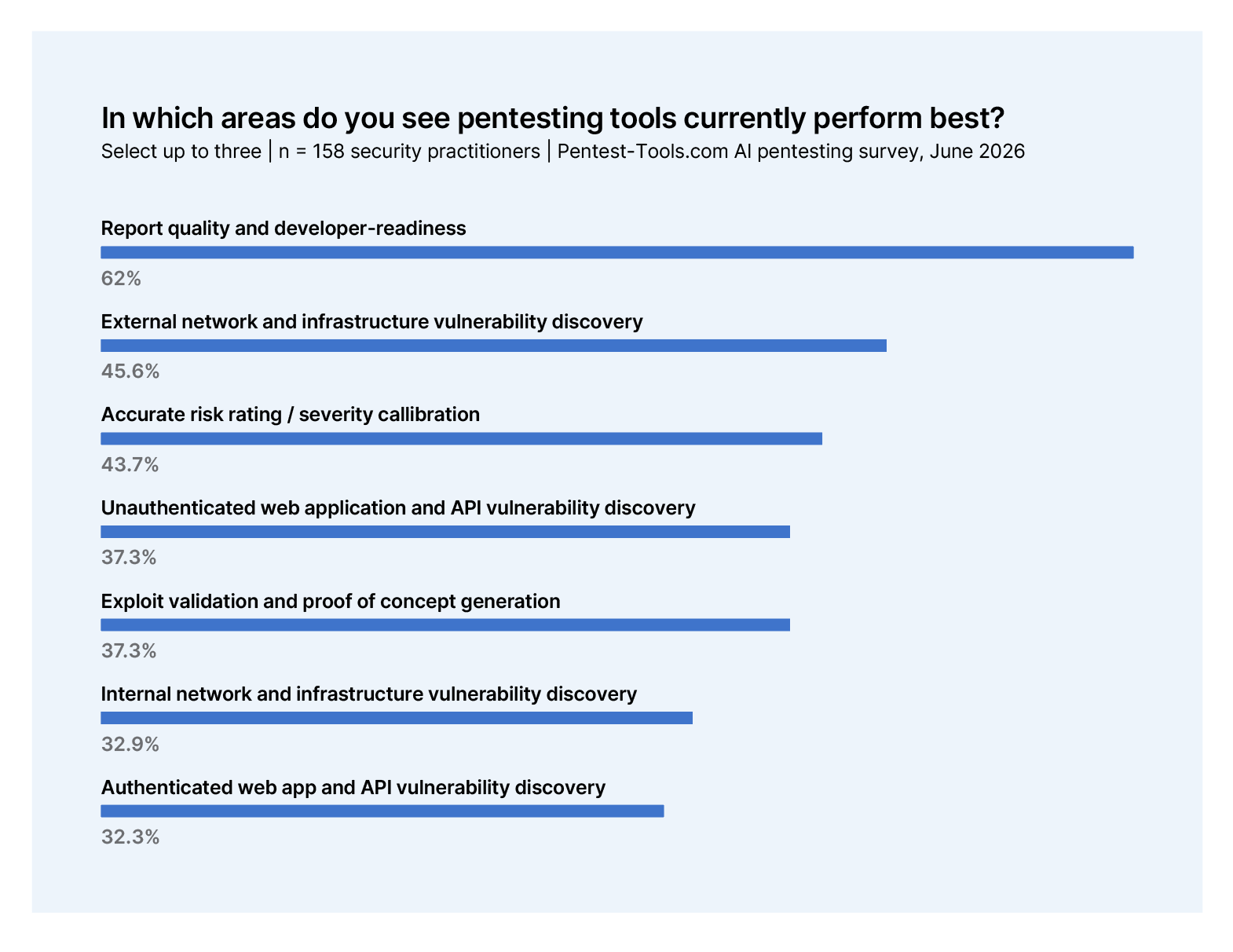

AI's real footprint in pentesting sits at the edges of the engagement, not the middle.
That’s because a botched exploitation step on a production system has no safety net.
The rest of this survey explains the experience behind this.
The time AI saves on vulnerability discovery comes back as triage
AI accelerates vulnerability discovery. That part of the promise holds up.
What surprised many practitioners is where the work went afterward.
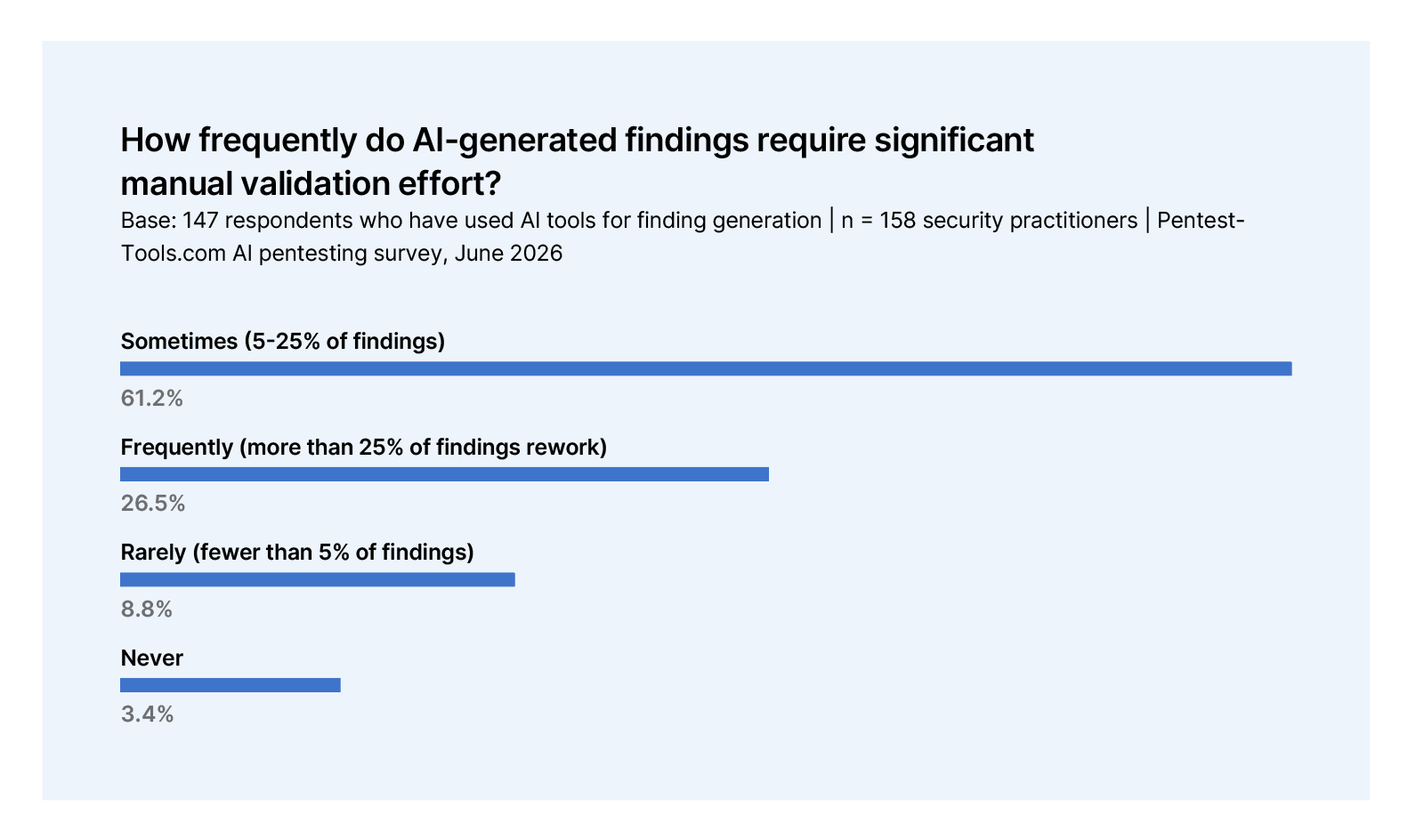

AI findings still require heavy manual rework
Among the 147 respondents who have used AI tools for finding generation, 87.8% ran into findings that require significant manual validation either sometimes (61.2%, meaning 5-25% of findings) or frequently (26.5%, meaning more than a quarter of findings need rework).

Scanning volume creates a validation bottleneck
Scanning and discovery is also where practitioners use AI most (74.1%), so the validation debt accumulates precisely in the highest-traffic phase.

An AI tool spits out 300 findings. I spent two days triaging, and 250 were junk (duplicate vulns, potential SQLi that is not exploitable, or AI-made-up CVEs that do not exist). I bought the tool to save time, but I did more manual work than before.
Survey respondent
Many practitioners expected AI to remove manual work.
Instead, several described buying a tool to save time and ending up spending that time on triage. The effort moves downstream, from finding vulnerabilities to deciding which findings are real and which matter.
Hallucinated findings erode trust faster than missed vulnerabilities
Validation workload is a capacity problem. Hallucinated findings create a different problem: they make teams question whether they can trust the output at all.
When we asked practitioners about their biggest frustration with AI pentesting tools, roughly 30% of the responses (51 of 156) named false positives, hallucinated exploits, or fabricated findings, making it the most common frustration by a wide margin.
Practitioners described AI-generated vulnerabilities that looked convincing but which they couldn’t reproduce, fabricated exploits and CVEs, and findings that were technically correct but ignored organizational nuances.

Findings that are technically correct but ignore nuances. As well as some findings that have been entirely made up.
Survey respondent
The cost compounds
Once practitioners catch a fabricated finding, they stop extending the benefit of the doubt to genuine ones. Confidence becomes conditional rather than assumed, and every subsequent finding inherits the extra scrutiny.
A tool only has to hallucinate convincingly once to change how a team treats everything it produces afterward
Business logic is the gap AI cannot close, and practitioners know exactly why
Across three open-ended questions, business logic understanding was the limitation practitioners named most often, well ahead of the second most cited gap, complex attack chaining and creativity.
The responses were specific, not vague complaints about AI limitations. Practitioners described exactly where pattern matching stops and contextual reasoning has to take over: AI tools struggle to grasp how an application is supposed to behave, what the organization intends its controls to do, and why certain data matters more than other data.
A vulnerability like this produces no error, no signature, and no anomaly in the code.
The application works exactly as it should. That’s why you need to understand intent to recognize an attacker can abuse the workflow itself - and that understanding still belongs to the human tester.
Practitioners’ usage choices already reflect this: they use AI the least in exploitation and post-exploitation, which is where understanding intent matters most.
AI pentesting tools can actually find SQL injections, but they won't understand 'this discount coupon should only work once per customer' and then also break the cash flow to abuse it. However, humans understand how the app is supposed to work. We find logic bugs like adding negative quantities to the cart is equal to free money, or changing the user ID in the URL to see other people's data, which doesn't require a signature.
Survey respondent
Only frequent testers with mature processes can absorb AI volume
Practitioners already confirm AI can produce more findings. However, they’re far less confident their teams can review, reproduce, and prioritize those findings fast enough to make them actually useful.
Asked whether their team could triage and validate more than 500 AI-generated vulnerability candidates from a single engagement, only 20.3% said they already have a workflow for it. Another 38.6% said the volume would strain the team, and 29.7% said it would be unmanageable.
Note: Because our sample size for the highest-frequency groups is small, we consider these findings to be a directional trend.
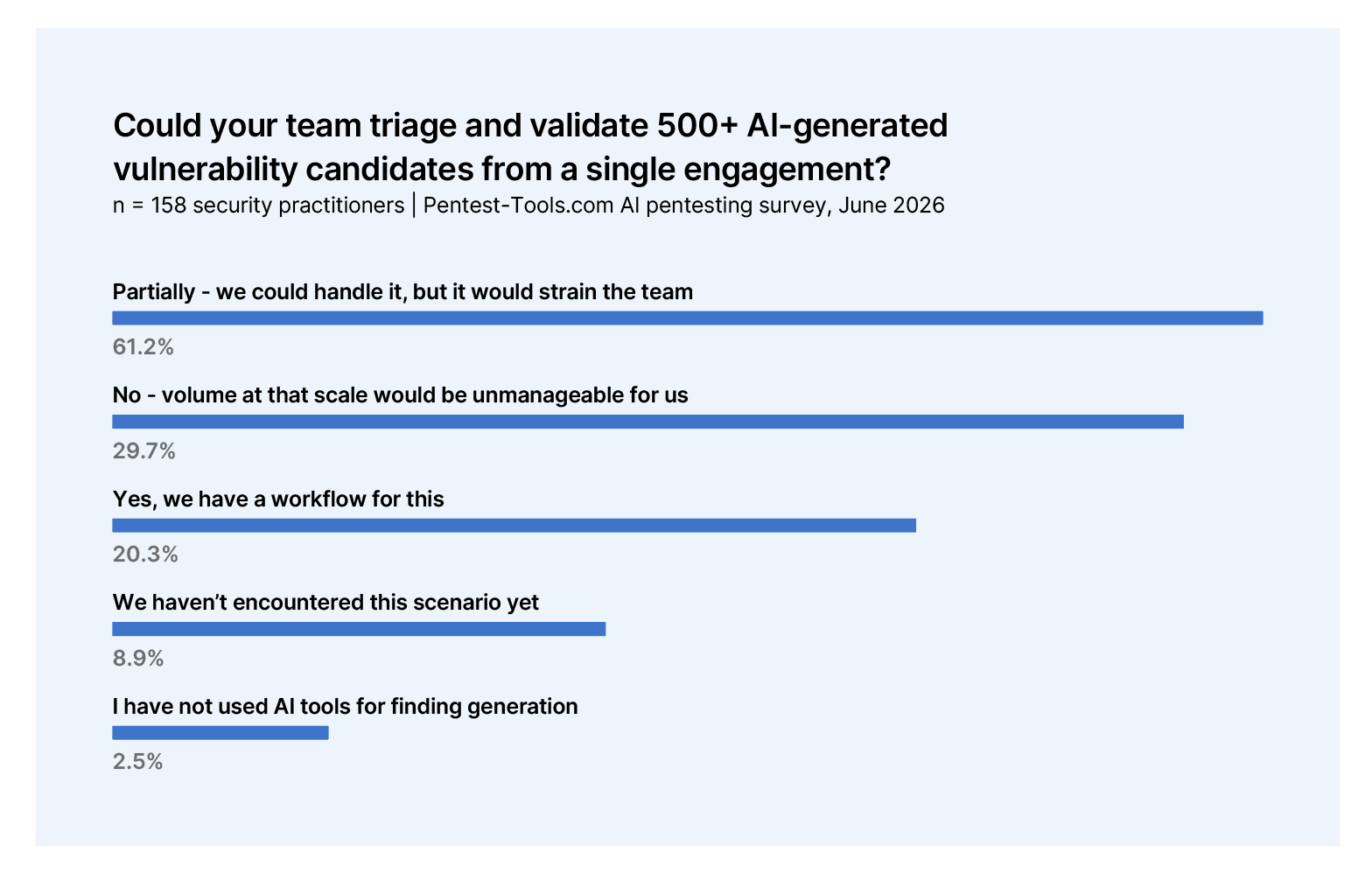
Nearly 7 in 10 teams could not confidently absorb the output volume that current AI tooling can generate.
Triage efficiency depends more on testing frequency than on company size.
Among teams running fewer than 5 tests per month, only 4% have a formal workflow for managing high-volume AI findings, and 55% find the workload unmanageable.
Conversely, teams that test more frequently are better prepared.
They’re more likely to have established workflows and less likely to feel overwhelmed.
This is where AI efficiency stalls and creates a critical risk in vulnerability management
Public attention around frontier AI models focuses on how quickly they can discover vulnerabilities. But discovery has never been the real bottleneck.
The open-source patch gap
When we asked practitioners what concerns them most about AI-found vulnerabilities being disclosed at scale across open-source projects, 41% pointed to the gap between disclosure and patching, and another 24% worried that adversaries may find the same vulnerabilities before patches ship.
AI scales vulnerability findings, not fixes
Offensive security creates value when teams can reproduce a finding, confirm exploitability, prioritize it, and hand developers something they can act on. AI changes how many findings enter that pipeline, not how quickly organizations move through it.
The real bottleneck is testing maturity
Teams that already run tight, frequent processes absorb the extra volume. Teams without an established pipeline get buried by it.
I feel like what is missing the most is to critically expose the vulnerabilities. I do not need a report with 1000 vulns, because my org will never be able to actually tackle them. I need the ones that are more easily exploited and which target critical assets.
Survey respondent

Stakeholder expectations are shifting faster than budgets
The pressure practitioners feel comes from outside the security team as well.
37.3% of respondents say internal stakeholders now demand more frequent testing than 12 months ago, based on being more aware of AI-assisted attacks.
Rising demand for testing outpaces validation resources.
Another 31.6% say stakeholders are aware of the risk shift but have not changed buying behavior yet. The awareness is there; the decision cycle has not caught up. For practitioners, that means demand for testing is likely to keep rising while the resources to validate the results lag behind, which makes the triage capacity gap described above more urgent.
Whatever value AI delivers in security testing depends on the workflows and processes already in place.
AI will not fix systemic organizational issues. It exposes them at scale, and the teams that benefit most from it are the ones that built their validation and prioritization muscles before the volume arrived.
Most AI systems get tested only when someone asks
AI system testing is quickly becoming part of the scope of everyday security work. 75.3% of surveyed practitioners already test AI-powered systems or LLM-integrated applications as part of their engagements: 25.9% do it regularly and 49.4% when clients or stakeholders specifically request it. Another 17.1% expect to start within 12 months.
Taken together, 92.4% of practitioners either already test AI systems or plan to within a year. Only 7.6% neither test AI systems today nor anticipate doing so soon.
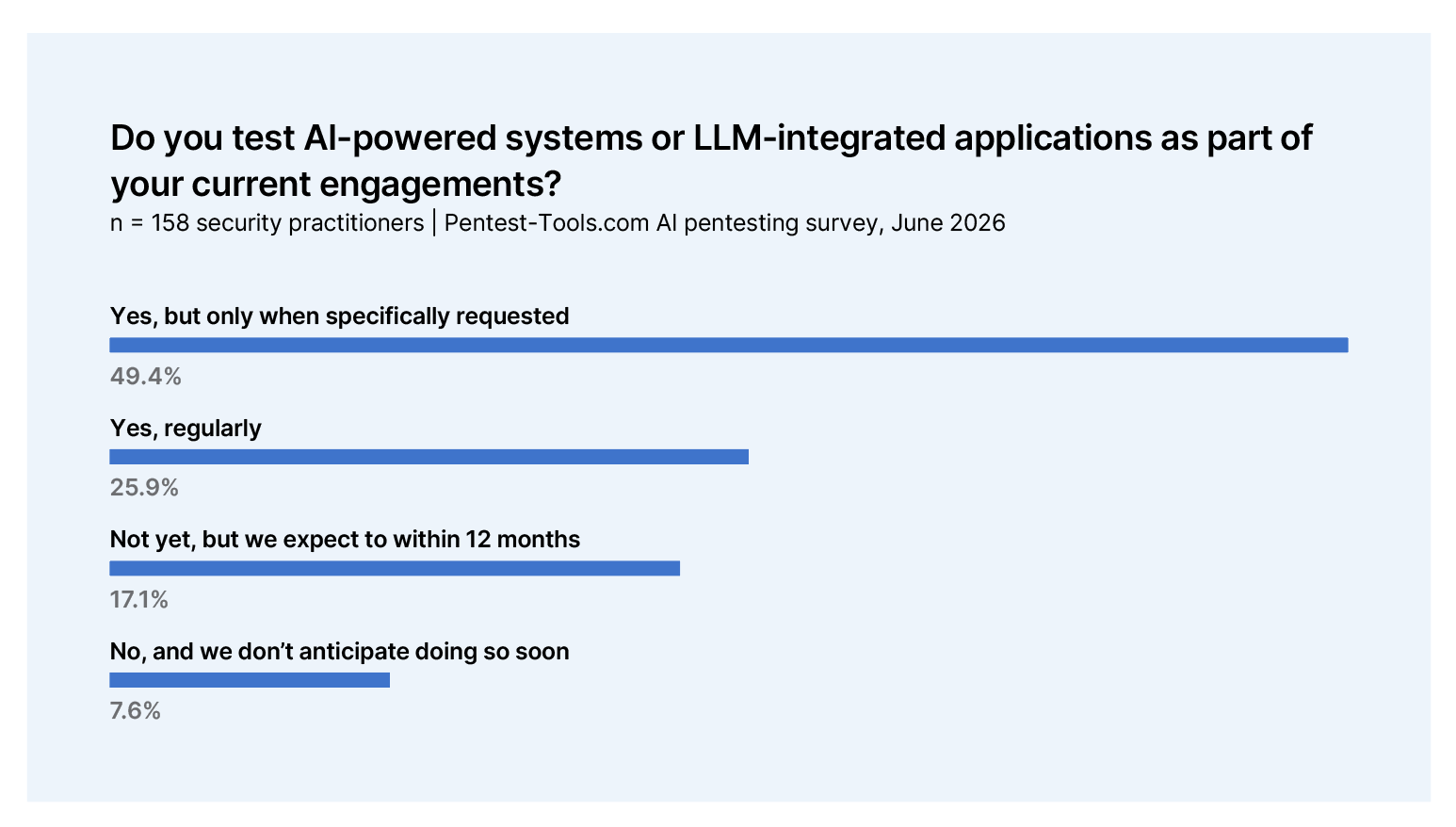
The scope of what practitioners assess is expanding alongside organizational AI adoption.
One in three (33.5%) already includes risks created by employees' unauthorized AI use in their assessment scope, and another 53.2% have discussed adding it but have not formalized the process yet.
Shadow AI is on almost everyone's radar and formal coverage is still catching up.
Practitioners buy signal quality before they buy speed
The evaluation criteria practitioners apply to AI-assisted pentesting platforms mirror the frustrations they described.
Two accuracy-related factors outrank cost. Practitioners have learned, often the hard way, that a cheap tool producing noise costs more than it saves. Notably, 39% also put data handling among their top three concerns, a reminder that feeding vulnerability data into AI systems raises its own trust questions.
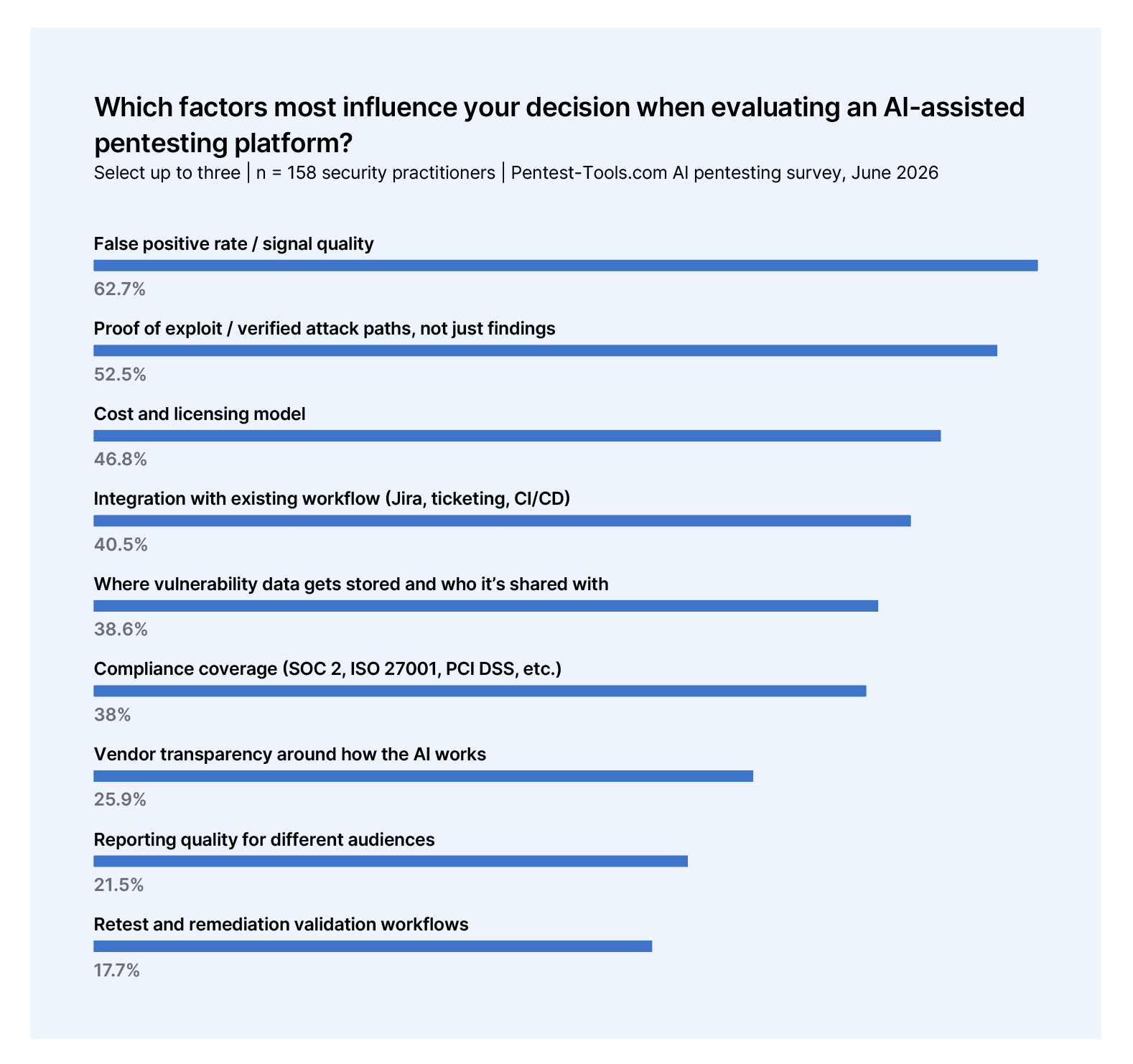
Asked which factors influence their decision most when evaluating a platform, practitioners ranked accuracy and proof above price.
False positive rate / signal quality: 63%
Proof of exploit / verified attack paths, not just findings: 53%
Cost and licensing model: 47%
Integration with existing workflow: 41%
Where vulnerability data gets stored and who it's shared with: 39%
Two accuracy-related factors outrank cost.
Practitioners have learned, often the hard way, that a cheap tool producing noise costs more than it saves. Notably, 39% also put data handling among their top three concerns, a reminder that feeding vulnerability data into AI systems raises its own trust questions.
Get the full survey results
Get the PDF report to share with colleagues, peers, stakeholders, and anyone who needs to see others are going through the exact same challenges.
Methodology
Pentest-Tools.com gathered insights from 158 security practitioners
Between June 17 and 18, 2026, our team fielded an online questionnaire to capture the latest perspectives and trends directly from cybersecurity professionals. All respondents were screened for using AI-assisted vulnerability assessment and validation tools in their work.
Respondent profile: security roles and organization sizes
Respondents included security engineers (23%), IT managers (22%), penetration testers and red teamers (18%), DevSecOps and AppSec professionals (15%), consultants and MSSP practitioners (10%), security managers and CISOs (7%), and other roles responsible for offensive security (4%). They test or secure organizations of all sizes, from fewer than 100 employees to more than 5,000, with the largest share (35%) working with organizations of 100-999 employees.
About the data
Percentages are based on all 158 respondents unless otherwise noted. The manual validation frequency statistic is based on the 147 respondents who have used AI tools for finding generation. Respondent quotes are lightly edited for spelling and grammar only; meaning is unchanged.

This is one data point. The pattern is bigger.
Every report on Insights starts the same way: we ask the people doing the work, not the people buying the tools. Read them together and the patterns get hard to ignore.