
AI Pentests - autonomous web app pentests powered by Specter
AI Pentests autonomously investigates your web application, follows attack paths, validates exploitability, and reports only findings it can prove with reproducible evidence.
You define the scope. Specter handles the full pentest - from recon to reports that support SOC 2, ISO/IEC 27001, NIS2, DORA, and HIPAA compliance.



Built to run complete penetration testing engagements
Autonomous reasoning is only one part of an AI pentest.
AI Pentests powered by Specter combine AI with the offensive security logic, testing harness, exploit validation, evidence capture, execution history, scope controls, and reporting required to execute a complete web application penetration test from start to finish.
Because a successful pentest requires more than good prompts.

First public run, real feedback
We brought AI Pentests to DEF CON 34 for its first public preview, then took the same questions to Black Hat. Here's what practitioners actually said.



Another AI pentesting tool? Why?
Because your team deserves more than a wrapper around an LLM.
And because AI is only as good as the offensive security knowledge behind it.
We’re bringing you an AI Pentests capability that:
→ is battle-tested in bug bounty programs and live engagements
→ provides deterministic coverage - ensured by our powerful tools
→ delivers only validated exploits - with zero false positives
→ produces compliance ready pentest reports


Pentest more often without inflating the triage queue
87.8% of 158 security practitioners who used generic AI models for pentesting said LLMs gave them findings that needed significant manual validation before they could act on them.
In our AI Pentests reports, every finding is a validated attack scenario.
Test exactly what changes, when it changes
A critical web app ships a new authentication flow on Tuesday. You can’t wait for the next scheduled engagement to know if it holds.
Scope the pentest to one app or one flow, run it on demand, and get validated findings in hours.
Built on more than a decade of offsec experience
AI is changing penetration testing. But it doesn’t replace years of hands-on vulnerability research, product development, and pentest engagements.
AI Pentests builds on all the offensive security capabilities our team has been refining since 2017.
Your autonomous pentest doesn’t start from a blank prompt. It starts from proven offensive security knowledge.
Meet Specter - our autonomous pentesting engine
Specter is the autonomous penetration testing engine behind AI Pentests that our team built.
AI Pentests powered by Specter
Unlike a standalone LLM, Specter combines autonomous logic provided by frontier AI models with deterministic vulnerability validation, which we’ve been developing for over a decade. That combination delivers something neither approach achieves on its own.
Autonomy
Explores independently.
Our AI Pentests capability forms hypotheses from the web app’s behavior, tests them, and either gathers evidence or moves on.
Coverage
Uses context to choose relevant tests.
Specter spends more time on relevant areas instead of executing a fixed checklist against every target.
Depth
Investigates attack paths.
Our AI Pentests follow an attack path across multiple steps. That’s because Specter chains weaknesses when the evidence supports it.
Accuracy
Validates exploitability.
The LLM harness we developed in-house proposes and executes attack scenarios. A finding only makes the report once controlled exploitation confirms it.
Visibility
Transparent execution.
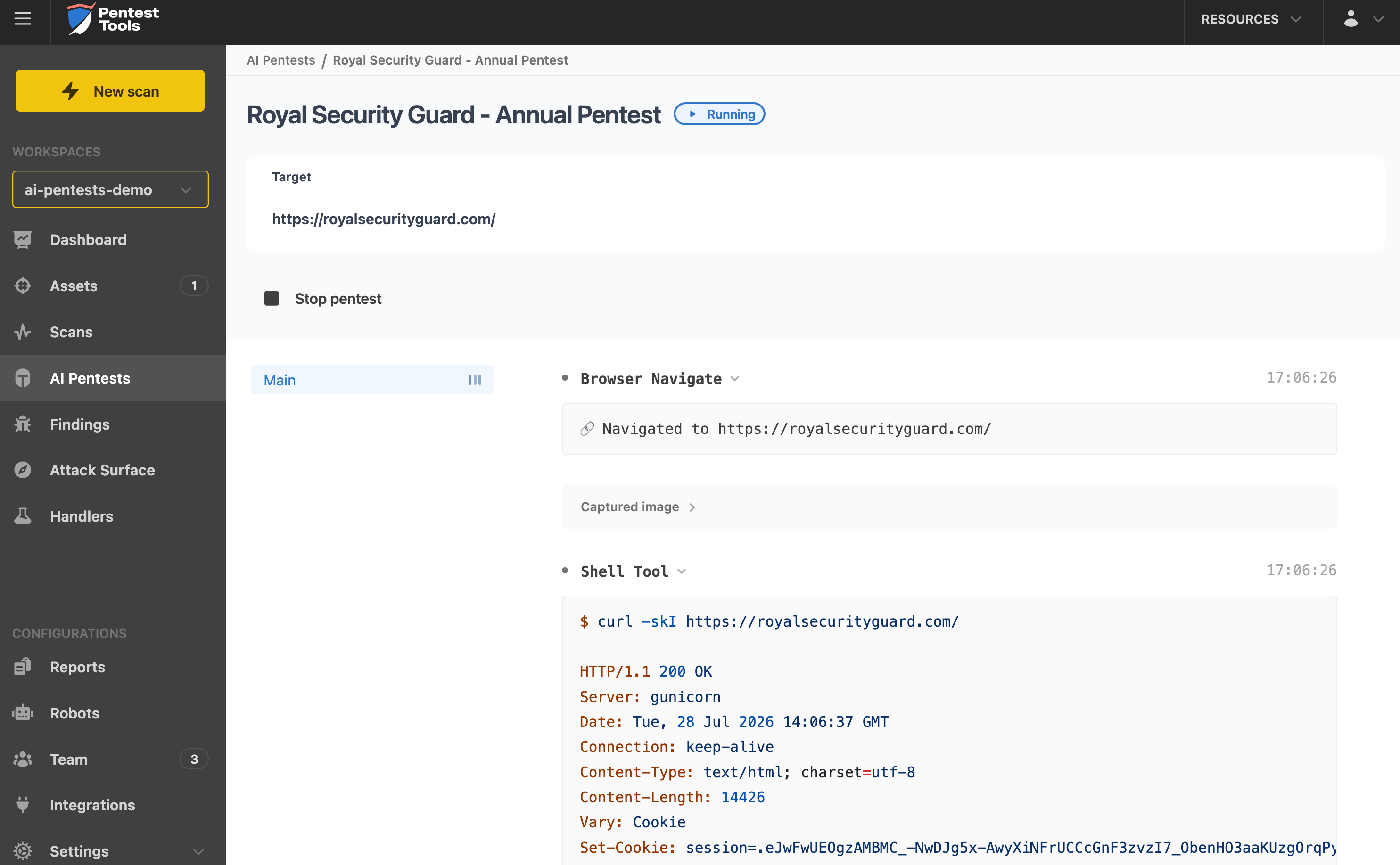
The activity log records everything: requests, responses, exploit attempts, decisions, and collected artifacts.
Repeatability
Reports reproducible evidence.
Every finding Specter delivers comes with independently verifiable evidence, including steps to reproduce it. Because if you can't reproduce it, you shouldn't have to fix it.
Why did you call it Specter?
We named it Specter as a nod to the James Bond universe and the mindset of great intelligence operatives: curious, methodical, adaptable, and always thinking a few steps ahead.
Those same qualities define great pentesters. And Specter brings that investigative approach to web application security, acting as a trusted ally when your team’s time and resources are stretched thin.

Get access to AI Pentests powered by Specter
One engagement: independent investigation, validated exploitability, and evidence you can inspect end to end, inside the workflow your team already runs.
How AI Pentests work
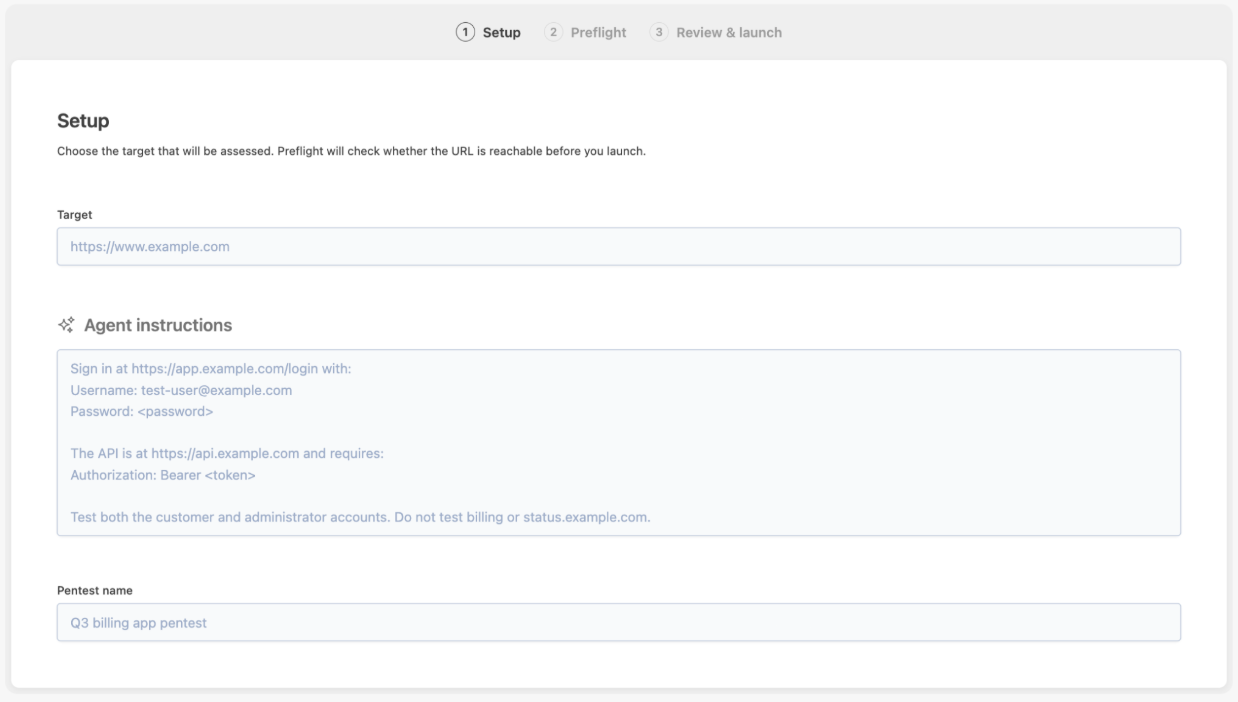
1. Your team sets the context
Every engagement begins with practitioner intent.
Your team defines the authorized scope, testing mode, and reporting instructions.
AI Pentests powered by Specter decides how to investigate within those boundaries.
2. Specter investigates like an experienced pentester
Understands the target
Every experienced pentester begins by building situational awareness. So does Specter.
It enumerates the application, builds a working model of how it behaves, identifies its attack surface, and forms initial hypotheses worth investigating.
Investigates attack paths
Rather than executing a fixed checklist, Specter follows the evidence.
It investigates promising hypotheses, chains weaknesses together when appropriate, and abandons investigations that no longer produce evidence.

Proves exploitability
Every suspected issue must earn its place in the report.
Specter performs controlled exploitation to confirm exploitability and collects reproducible evidence before including it in the report.
Documents everything
Transparency is part of every engagement.
Specter records every request, response, decision, exploit attempt, and collected artifact, giving your team full visibility into how it reached each conclusion.
Produces a ready-to-use report
Every AI pentest produces a structured pentest report.
Your team receives the report together with the complete activity log. Practitioners can review validated findings, replay attack paths, and confidently communicate the results.

Built for teams that need deeper testing more often
Internal security teams
Validate exploitability without spending the week rechecking scanner output. Use Specter when a critical web app changes, a recurring scan needs deeper investigation, or stakeholders ask for evidence before the next scheduled manual pentest.
MSPs and MSSPs
Add a client-facing assessment tier between recurring vulnerability scans and a full manual engagement. Scope each pentest to the relevant client application, review the evidence, and deliver a structured report.
IT teams
Move beyond a yearly or quarterly snapshot without requiring an in-house pentesting team for every application change. Specter confirms exploitable findings and presents evidence for engineering, management, customers, and auditors.
Why choose AI Pentest for your web apps
Know the price before the pentest starts
Predictable pricing makes deeper testing practical.
Instead of waiting for the next scheduled engagement or requesting a custom quote, your team can launch an AI pentest whenever a critical application or workflow changes, knowing the cost before the assessment begins.
Go deeper without building your own AI pentesting system
A frontier AI model can help an experienced practitioner write payloads, interpret responses, or plan the next test. Turning that capability into a controlled, repeatable pentesting workflow is the difficult part.
AI Pentests powered by Specter combine autonomous reasoning with the testing harness, offensive security logic, exploit validation, evidence capture, execution history, scope controls, and reporting required to run a complete engagement - not just individual prompts.
Add it to your flow without changing how you work
AI Pentests complements the workflows your team already relies on.
Use recurring vulnerability scans for continuous coverage. Run AI Pentests when a critical application, authentication flow, or high-risk change needs deeper investigation before (or instead of) the next scheduled manual engagement.
Spend less time proving your findings are real
Every finding includes the evidence behind it.
Specter validates exploitability before adding a finding to the report, then documents the attack path, supporting artifacts, and reproduction steps so your team can spend less time verifying results and more time acting on prioritized issues that need fixing.
Give each stakeholder the evidence they need
A successful pentest doesn’t end with validated findings. It ends with evidence every stakeholder can understand and act on.
Engineers need technical proof. Security teams need reproducibility and prioritization. Leadership needs business context. Customers and auditors need evidence they can inspect.
AI Pentests structures every report so each audience gets the level of detail they need without losing the complete investigation behind it.
Security teams get reproducible evidence
Every confirmed finding includes the technical evidence needed to independently verify the result.
Review attack paths, replay exploit attempts, inspect supporting artifacts, and understand exactly how Specter reached each conclusion before deciding what deserves remediation.
Examples include:
→ HTTP requests and responses
→ payloads
→ screenshots
→ exploit output
→ attack flow diagrams
→ replay steps
→ execution logs
→ collected artifacts
Engineers get actionable remediation guidance
Every finding explains more than what happened.
It documents why the issue matters, how Specter confirmed exploitability, how to reproduce the behavior, and the recommended remediation, together with CVSS, CWE, and OWASP mappings that help prioritize the work.
Leadership gets business context
Not every stakeholder needs to inspect payloads.
The executive summary highlights the assessment scope, confirmed attack scenarios, business impact, and remediation priorities so leadership can quickly understand the outcome of the engagement.
Auditors and customers get evidence they can inspect
Compliance reviews require more than a list of vulnerabilities.
AI Pentests reports help support evidence collection for frameworks such as SOC 2, ISO/IEC 27001, NIS2, DORA, the Cyber Resilience Act, and HIPAA by documenting validated attack scenarios together with the evidence behind them.
The AI pentest report supports security reviews and audit preparation. Acceptance always depends on the applicable framework, auditor, customer, jurisdiction, and engagement requirements.
Practitioners get complete transparency
AI Pentests doesn’t just show conclusions.
The complete activity log records every investigation, hypothesis, request, response, exploit attempt, abandoned path, and collected artifact, allowing practitioners to inspect the assessment from beginning to end.
Because practitioners deserve transparency - not black boxes.
FAQs about AI Pentests powered by Specter
What kind of penetration test does AI Pentests perform?
AI Pentests performs black-box and gray-box web application penetration tests.
By default, Specter assesses the deployed application from the outside, just as an external attacker would. When you provide supported authentication credentials or API tokens, it can extend the assessment to authenticated areas of the application while remaining within the authorized scope.
How is AI Pentests different from a vulnerability scanner?
Vulnerability scanners identify potential weaknesses across many assets. AI Pentests investigates a single web application in greater depth, follows attack paths, validates exploitability, and reports only findings it can prove.
How is AI Pentests different from using a frontier AI model?
A frontier AI model can assist with individual pentesting tasks. Specter turns that capability into a controlled, repeatable penetration testing workflow with scope enforcement, target interaction, exploit validation, evidence capture, execution history, and reporting.
Unlike a standalone LLM, your autonomous pentest doesn’t start from a blank prompt. It starts from proven offensive security knowledge, refined through more than a decade of building Pentest-Tools.com.
Can AI Pentests replace a manual pentest?
No.
AI Pentests helps teams investigate more applications more often. Experienced practitioners still provide business context, authorization, edge-case analysis, and the judgment required for complex security decisions.
Does Specter test business logic?
Specter investigates application behavior and follows attack paths where the evidence leads. It does not understand every organization’s intended business rules and should not be considered complete business logic testing.
What do I need before starting a penetration test with AI Pentests?
An authorized web application URL and the scope you want Specter to assess. You can also provide authentication credentials or API tokens if you want AI Pentests to dig even deeper.
Do I need access to the source code?
No.
AI Pentests begins from the deployed application, just as an external attacker would.
Can I test authenticated applications?
Yes, where supported.
You can provide authentication details as part of the engagement to extend testing beyond public functionality.
Can I scope the pentest to a specific workflow?
Yes.
You can focus an engagement on a particular application, feature, or authentication flow instead of testing an entire environment. You can describe your goals and context Specter needs to follow in the Setup step.
When should I use AI Pentests instead of recurring vulnerability scans?
Use recurring scans for continuous coverage and/or vulnerability monitoring.
Use AI Pentests when a specific application or workflow requires deeper investigation and exploit validation.
Is it safe to run AI Pentests against production?
AI Pentests operates within the authorized scope you define before the engagement begins.
It’s important to know any penetration test carries a certain level of risk, so we recommend testing non-production environments if possible.
An AI Pentest exploits what it finds instead of just flagging it. That's what makes the findings trustworthy, and also what makes it noisy: confirming a SQL injection means reading real data, so production records can show up in your report. Exploitation leaves test accounts and submitted forms behind. Fuzzing adds traffic and can trip rate limits or your WAF. Your monitoring will notice, so warn whoever is on call.
Please make sure to carefully read the details under Launch acknowledgements in the Review & launch setup step before starting the AI pentest.
Can I stop an AI pentest while it’s running?
Yes, you can stop the pentest anytime. The AI pentests can take a few moments to reach a full stop.
The partial assessment remains available for review but you won’t be able to generate a pentest report for the partial results. This is why the “Generate report” button will not appear when you stop an AI pentest.
What does Specter record during an AI pentest?
The activity log records requests, responses, decisions, exploit attempts, collected artifacts, and other execution details needed to review the assessment.
What evidence is included in the report?
Every validated finding includes reproducible evidence such as HTTP requests and responses, payloads, screenshots, attack flow diagrams, exploit output, and replay information where applicable.
Does the report include unsuccessful investigations?
No.
The AI Pentests report only includes validated findings along with the proof that supports them.
The complete activity log records both successful and abandoned investigation paths, giving practitioners full visibility into how Specter reached its conclusions.
Can the report support compliance reviews?
Yes.
The report can support evidence collection for frameworks such as SOC 2, ISO/IEC 27001, NIS2, DORA, the Cyber Resilience Act, and HIPAA.
Acceptance always depends on your auditor, customer, jurisdiction, and penetration testing requirements.
What happens to my pentest and application data?
Assessment data remains within your Pentest-Tools.com workspace and follows the applicable retention and deletion controls.
Is my application data used to train AI models?
No. We don't train models on your data, and the providers we use exclude API traffic from training under their commercial terms.
Which AI model powers Specter?
Specter combines proprietary orchestration, offensive security logic, and deterministic validation with large language models.
How is AI Pentests priced?
AI Pentests uses a per-engagement pricing model, with the applicable price displayed before the assessment starts.
What is autonomous penetration testing?
Autonomous penetration testing uses AI to perform parts of a penetration test independently, including investigation, exploit validation, and evidence collection, while practitioners remain responsible for defining scope, reviewing results, and making security decisions.
What is exploit validation?
Exploit validation is the process of confirming that a suspected vulnerability can actually be exploited under controlled conditions.
Why does AI Pentests focus on evidence instead of the number of findings?
More findings do not necessarily improve the efficiency of a security program.
AI Pentests prioritizes validated attack scenarios over raw detection, helping teams spend less time verifying results and more time fixing confirmed risks.
Why doesn’t AI Pentests report every possible vulnerability?
Because a penetration test is an investigation, not a competition to generate the longest findings list.
Specter prioritizes validated attack scenarios supported by reproducible evidence, helping your team focus on issues they can confidently understand, prioritize, and remediate.
What 158 practitioners told us about using frontier AI for pentesting
87.8% of practitioners said AI-generated findings still require significant manual validation before they can act on them.
Read what security professionals value most in AI pentesting - and why signal quality and proof of exploit matter more than speed.