
Free Apache HTTP/2 vulnerability scanner - detect CVE-2026-119618 RCE
Scan your Apache server for CVE-2026-119618, the critical mod_http2 flaw that can lead to remote code execution, and download a PDF report with the documented finding.
It shows if your server runs an affected Apache version and negotiates HTTP/2, the version and protocol evidence behind the result, and the fixed release to install. The check sends no request that can crash Apache.
Already patched or turned off HTTP/2? Use this free vulnerability scanner to see if your server still matches the affected profile.
- Scan type
Light scan
Scan your Apache server for CVE-2026-119618, the critical mod_http2 flaw that can lead to remote code execution, and download a PDF report with the documented finding.
It shows if your server runs an affected Apache version and negotiates HTTP/2, the version and protocol evidence behind the result, and the fixed release to install. The check sends no request that can crash Apache.
Already patched or turned off HTTP/2? Use this free vulnerability scanner to see if your server still matches the affected profile.




Does CVE-2026-119618 affect my Apache HTTP Server?
If your server runs Apache HTTP Server 2.4.55 through 2.4.70 with HTTP/2 enabled (h2 or h2c in a Protocols directive), probably yes, unless your distribution backported the fix.
Update to 2.4.71 or your distribution's patched package, then restart Apache. Servers that only serve HTTP/1.1 aren't affected.
Run the scan above to check what your server reports.

How we detect CVE-2026-119618 in Apache HTTP Server
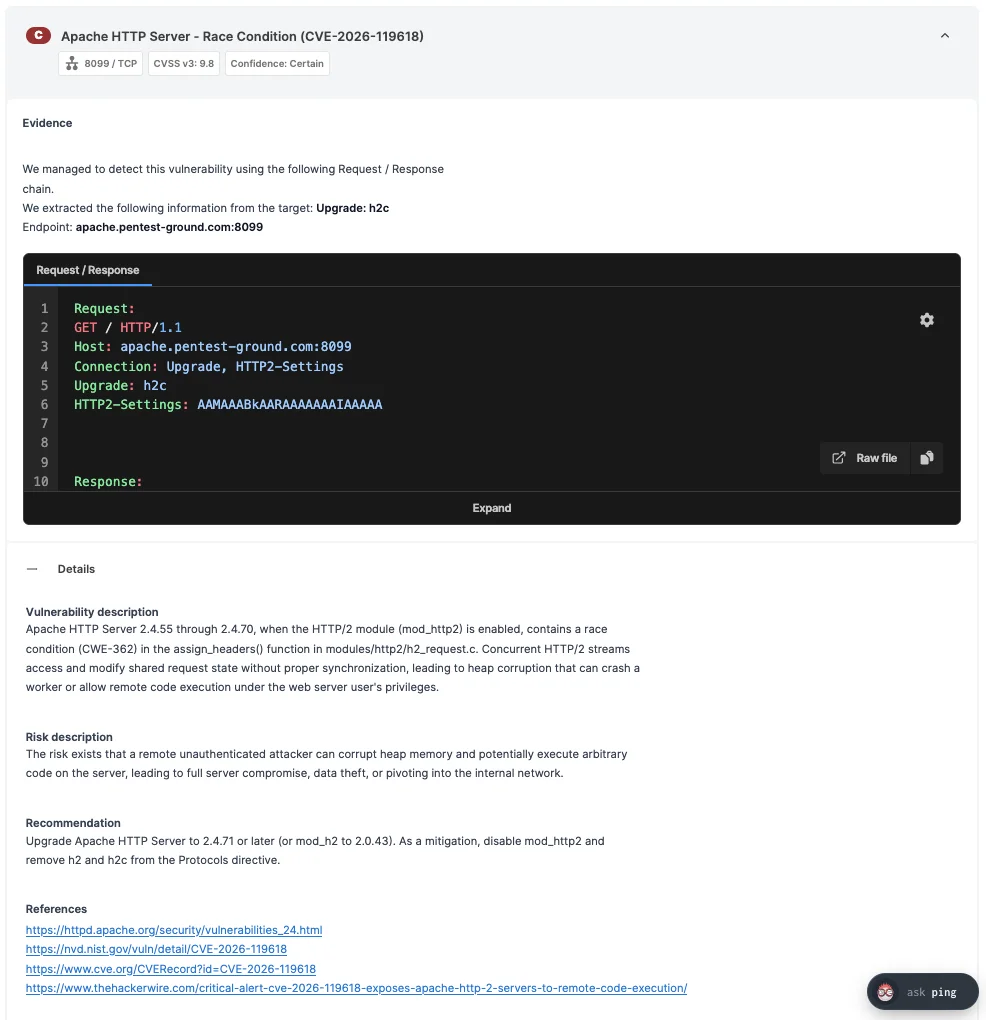
The only way to confirm CVE-2026-119618 directly is to trigger the race in assign_headers(), and that request corrupts memory and crashes Apache child/worker processes. We don't send it.
Instead, the scanner checks the two conditions the flaw needs: an affected Apache version and HTTP/2 support.
- Method: the scanner connects to ports 443, 8443, and 80, asks for HTTP/2 through ALPN on TLS ports and through an
h2cupgrade on plain HTTP ports, and reads the Apache version from theServerheader. - Match condition: the target reports Apache 2.4.55 through 2.4.70 and negotiates HTTP/2.
- Limitations:
- RHEL 9 and 10, AlmaLinux, Fedora, and Azure Linux ship the fix as a backport, so a patched server can still report an older version. Check the installed mod_http2 package on the host.
- If the server hides its version (
ServerTokens Prod), the scanner can't conclude. - If a CDN or reverse proxy handles HTTP/2 in front of Apache, the scanner sees the proxy, and the result describes the proxy's protocol support.
- Protocols can differ per virtual host. The scanner tests only the hostname you enter.
- Safety: the check sends only standard HTTP requests and never sends the request that triggers the bug.
- CVE coverage: CVE-2026-119618 only. Apache 2.4.71 also fixes CVE-2026-106023 and CVE-2026-109163, which this scanner doesn't check.
- Evidence and confidence: each finding includes the version string, the negotiated protocol, and the port, and carries a Certain level of confidence.
Because CVE-2026-119618 exposes targets to a critical RCE risk, we needed to move fast for our clients. This is why our detection focuses on checking the Apache version (2.4.55–2.4.70) and checking if the server accepts the HTTP/2 protocol.
Time was too short to build a safe active check right out of the gate, especially since our lab tests on Apache 2.4.62 showed that winning the race corrupts the connection heap and can crash the httpd child process along with any live user traffic.
Our research team is looking into how we might trigger the bug safely down the road, while security teams can use this detection for immediate, zero-impact coverage right now.
Product Security Manager at Pentest-Tools.com



Free CVE-2026-119618 scanner report (PDF) sample
The report can help anyone who needs to patch or reconfigure Apache. For CVE-2026-119618, the vulnerability scan report includes:
the finding with the tested hostname and port, the reported Apache version, and the negotiated protocol
the fixed release (2.4.71) and the distro package path for backporting distributions
severity and step-by-step remediation, including the temporary
Protocolschange
The scan also collects open ports, DNS records, and detected technologies.
Download sample report (PDF)

What is CVE-2026-119618?
Technical details
CVE-2026-119618 sits in mod_http2, the Apache HTTP Server module that implements HTTP/2, and in the standalone mod_h2 project it came from. Apache disclosed it on November 11, 2026, with the fix in httpd 2.4.71. Anthropic's OSS Scanner and Google Cloud Vulnerability Research found it independently.
When an HTTP/2 request has no body, a Content-Type header, and no Content-Length, a worker thread adds a Content-Length: 0 header to a table that draws memory from the connection's shared, lock-free allocator, racing the connection thread for the same memory. The fix moves that write into memory the worker owns.
What an attacker can do by exploiting CVE-2026-119618
- Corrupt the heap of an Apache child/worker process with HTTP/2 requests, without credentials
- Potentially run code with the web server's privileges (Red Hat; public code shows the corruption, not code execution, as of November 12, 2026)
Any product that bundles Apache 2.4.55 to 2.4.70 with HTTP/2 inherits the flaw: container images built before November 11, appliances, and control panels that ship their own Apache build. Check those with the vendor.
Potential business impact: what this can mean for your organization
Public reproduction work already crashes Apache child processes, so availability is the most immediate risk for vulnerable Apache servers: dropped requests and failed checkouts, logins, or API calls each time a child process crashes, with repeated triggers degrading service until you patch or turn off HTTP/2.
If an attacker turns the memory corruption into code execution, here are a couple of scenarios to prepare for:
- A data breach that starts reporting clocks: 72 hours under GDPR for personal data, and a 24-hour early warning under NIS2 for organizations in scope
- Content you didn't publish served from your domain, which can get your site blocklisted by browsers and erode customer trust
- Recovery costs: rebuilding hosts, rotating every credential the server could read, and reviewing logs across the exposure window
- Compliance findings: PCI DSS v4.0 expects critical security patches within one month of release (Requirement 6.3.3)
For hosting providers and SaaS vendors, one compromised Apache server can potentially affect every customer site or tenant it serves.
Apache HTTP Server versions vulnerable to CVE-2026-119618
Apache HTTP Server 2.4.55 through 2.4.70 is vulnerable when HTTP/2 is enabled, as is standalone mod_h2 2.0.8 through 2.0.42.
| Branch or build | Support status | Vulnerable versions | Fixed in |
|---|---|---|---|
| Apache HTTP Server 2.4 (upstream) | Active | 2.4.55 through 2.4.70 | 2.4.71 |
| Apache HTTP Server below 2.4.55 | Active branch, older releases | Not affected by this CVE | Upgrade anyway: older releases miss other fixes |
| Standalone mod_h2 (GitHub) | Archived June 2026 | 2.0.8 through 2.0.42 | No standalone release; use the mod_http2 bundled with httpd 2.4.71 |
| RHEL 10 / AlmaLinux 10 | Vendor-supported | mod_http2 before 2.0.29-5.el10_3.1 | mod_http2-2.0.29-5.el10_3.1 |
| RHEL 8 and earlier | Vendor-supported | Not affected | - |
| Debian | Vendor-supported | Stable releases vulnerable as of Nov 12 | sid: 2.4.71-1; stable: pending |
| Azure Linux 4.0 | Vendor-supported | mod_http2 2.0.39 | mod_http2 2.0.42-2 with the CVE patch |
Two notes to consider when assessing your servers:
- distribution packages often carry the fix under an older version number, so check the package changelog, not only the version string.
- Embedded copies (appliances, control panels, bundled binaries, container images) need their own inventory.
CVE-2026-119618 severity score unpacked
- Apache: critical (textual rating, no CVSS score published)
- Red Hat: CVSS v3.1 base score 9.8 (
AV:N/AC:L/PR:N/UI:N/S:U/C:H/I:H/A:H), overall Critical; RHEL 9 and 10 packages rated Important because their builds give each HTTP/2 stream its own allocator - NVD: no score as of November 12, 2026
Scoring factors:
- No authentication required
- No user interaction required
- Reachable over the network, but only on servers that negotiate HTTP/2
What slows exploitation: the trigger needs a narrow request shape and timing window, per Helix ML's lab, and RHEL's allocator design raises the bar further.
The TL;DR for leadership: any internet-facing Apache 2.4.55 to 2.4.70 server that speaks HTTP/2 is exposed to an unauthenticated flaw with public crash reproduction and credible code execution, and upgrading or turning off HTTP/2 closes it.
CVE-2026-119618 disclosure timeline
| Date | Event |
|---|---|
| October 26, 2026 | Anthropic's OSS Scanner reports the flaw to the Apache security team |
| November 3, 2026 | Google Cloud Vulnerability Research reports it independently |
| November 11, 2026 | Apache releases httpd 2.4.71 with the fix and publishes the advisory on oss-security |
| November 11, 2026 | Wiz publishes cloud exposure data |
| November 12, 2026 | A public reproduction lab shows the heap corruption on 2.4.70 |
| November 12, 2026 | AlmaLinux and Azure Linux ship patched mod_http2 packages |
| November 12, 2026 | We add CVE-2026-119618 detection to the Network Vulnerability Scanner |
| November 12, 2026 | We launch this free vulnerability scanner for CVE-2026-119618 Apache HTTP2 RCE |

Use our free CVE-2026-119618 checker
CVE-2026-119618 exploitation - how attackers could use this Apache vulnerability
No credentials required: yes (Red Hat)
No user interaction required: yes (Red Hat CVSS vector)
Remotely exploitable: yes, on servers that negotiate HTTP/2
Public proofs-of-concept: a reproduction lab shows heap corruption on 2.4.70 and a clean 2.4.71 (googlesky lab). No public code reaches code execution as of November 12. Red Hat states public research demonstrated a reliable exploit against a default configuration.
Exploited in the wild: no reports as of November 12, 2026
CISA KEV: not listed as of November 12, 2026
If exploitation succeeds, an attacker can:
Run commands with the Apache worker's privileges
Read application code, configuration, and credentials that user can access
In containers, read mounted service account tokens or request cloud credentials from the metadata service, depending on the pod's setup
Change the content the server delivers, or use the host to move deeper into the network
Precedent: Apache's path traversal flaw CVE-2021-41773 got exploited in the wild, and PHP2Shell saw exploit attempts four days before its disclosure. A hard-to-weaponize bug can still move fast once one working exploit exists.
How to mitigate CVE-2026-119618
- Complete fix: upgrade to Apache HTTP Server 2.4.71 (Apache advisory).
- Upgrade path:
- Upstream builds: install 2.4.71.
- RHEL, AlmaLinux, Fedora: install the patched mod_http2 package from your vendor's errata.
- Debian and Ubuntu: watch your security tracker; Debian stable had no fix as of November 12.
- Standalone mod_h2 builds: switch to the mod_http2 module bundled with httpd 2.4.71.
- Containers: rebuild any image built before November 11 on a fixed base image.
- Appliances and control panels: ask the vendor for their fixed build.
- Verification: run
apachectl -v(orhttpd -v) andapachectl -M | grep http2on every host, check the package (rpm -q mod_http2ordpkg -l apache2), and confirm the protocol withcurl -sI --http2 https://your-host/. Then rescan with this scanner. - Temporary control (CVE-2026-119618 only): set
Protocols http/1.1in every config file and every VirtualHost block, then reload Apache. Clients fall back to HTTP/1.1. This doesn't address CVE-2026-106023 or CVE-2026-109163. - Monitoring option: watch the Apache error log for child process crashes (for example,
AH00052: child pid ... exit signal Segmentation fault) and assertion failures in mod_http2. A spike can signal trigger attempts. - Closing note: the
Protocolschange removes the path to this bug while it stays in place. Upgrading removes the bug.


Get your free CVE-2026-119618 scan report
CVE-2026-119618 references
- CVE-2026-119618 in the Pentest-Tools.com Vulnerability & Exploit DB
- Apache HTTP Server 2.4 vulnerabilities
- Apache fix commit 824beab9
- oss-security advisory, Eric Covener
- CVE.org record
- Red Hat CVE page
- AlmaLinux ALSA-2026:98978
- Azure Linux PR #20165
- Gentoo bug 986161
- NVD
- googlesky reproduction lab
- Helix ML analysis
- Wiz analysis
- The Hacker Wire coverage
About our Network Vulnerability Scanner
Our Network Vulnerability Scanner is a well-rounded tool for all your network security assessments.
It combines multiple engines and fine-tuned scan settings that surface more than 17,500 vulnerabilities, misconfigurations, and outdated services. Each scan automatically updates your attack surface.
See what else it can doCVE-2026-119618 FAQs
What is CVE-2026-119618?
A critical flaw in Apache HTTP Server's mod_http2 module. A race condition in assign_headers() lets one thread corrupt memory another thread uses, which can lead to remote code execution. It affects 2.4.55 through 2.4.70 with HTTP/2 enabled.
How does the CVE-2026-119618 scanner work?
It reads the Apache version your server reports and checks whether the server negotiates HTTP/2. It doesn't send the request that triggers the bug, because that request can crash Apache.
What are HTTP/2 and mod_http2?
HTTP/2 lets a browser send many requests at once over one connection. mod_http2 is the Apache module that implements it, and the Protocols directive turns it on with the h2 and h2c tokens.
Does turning off HTTP/2 protect against CVE-2026-119618?
Yes, while it stays off. Setting Protocols http/1.1 everywhere closes the path to this flaw, but not to the other two flaws fixed in 2.4.71. Upgrade when you can.
How widespread is the CVE-2026-119618 exposure?
Wiz found affected Apache versions in 64% of cloud environments, with publicly exposed instances in 51%. That counts versions only, so it marks the upper bound: servers without HTTP/2 aren't affected.
How do you tell if a server runs Apache with HTTP/2?
On the host, run apachectl -M | grep http2 and search your config for Protocols lines with h2 or h2c. Remotely, run curl -sI --http2 against the site, or use this scanner.
Is my RHEL server affected?
RHEL 8 and earlier aren't. RHEL 9 and 10 are affected until you install the patched mod_http2 package, and their builds make exploitation harder.
Why are you offering a free scanner for CVE-2026-119618?
Every day, our team develops tools, detections, and exploits to help security professionals find vulnerabilities before attackers can exploit them.
We know the fight is unfair: security teams follow strict rules, while threat actors do whatever they want. That's why we build free tools like this one, so security teams can validate their exposure quickly, without waiting for a scheduled scan or a costly engagement.