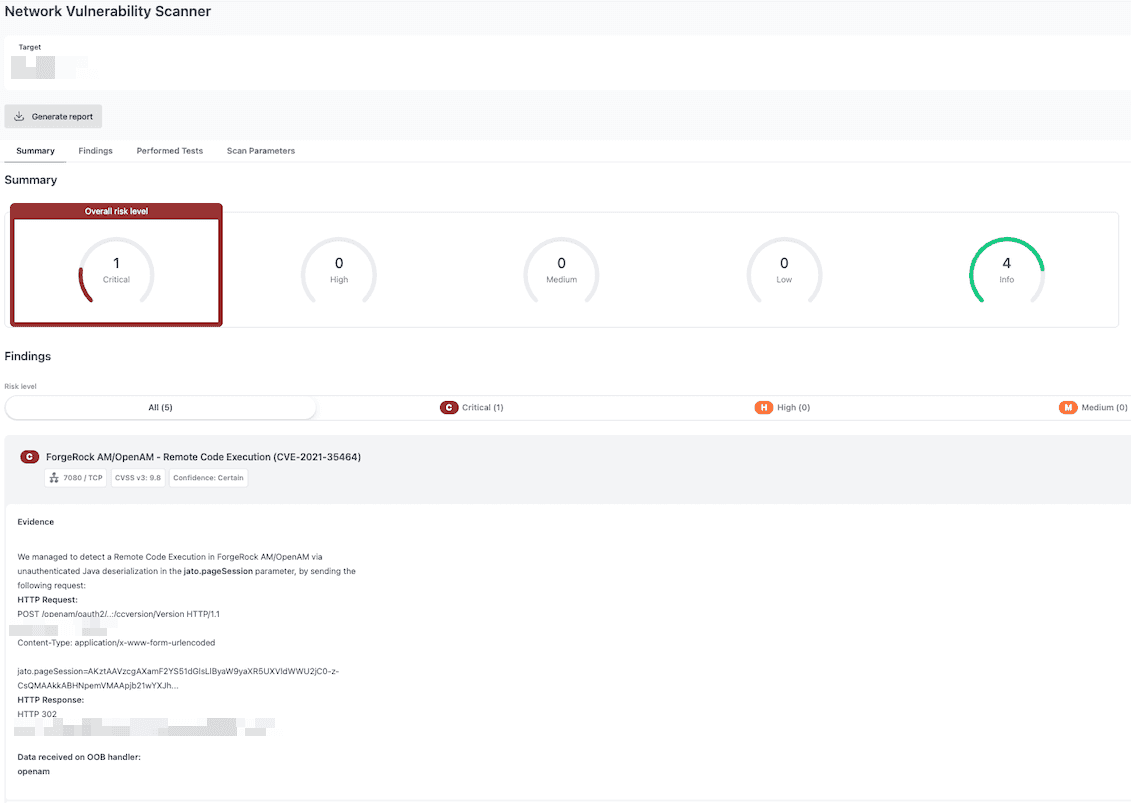

The Network Scanner also detects HTTP2Shell (CVE-2026-111497)
Copy link to “The Network Scanner also detects HTTP2Shell (CVE-2026-111497)”HTTP2Shell is another name for CVE-2026-111497, the Brotli decoder flaw we added to the Network Scanner as Node2Shell. The same detection covers it, so your existing scans already test for it.
How to confirm exposed or patched targets
Run a scan with the Network Scanner. It tests whether Node.js, Bun, and Envoy endpoints decode Brotli request bodies with a vulnerable decoder, so you see reachability instead of a version guess.
Open the PDF report when the scan completes. It includes:
the finding and the request and response behind it
the fixed release for Node.js, Bun, or Envoy
the CVSS score and severity rating
remediation steps you can hand to whoever owns the fix
Update to the fixed release for your runtime.
Re-scan to confirm remediation across all your assets.
❗ HTTP2Shell also reaches outbound clients, and no external scan can trigger those.
Python’s requests, urllib3, httpx, and aiohttp decode Brotli responses automatically whenever Brotli or brotlicffi is installed, even if your code never imports it. Check these by hand:
Run pip show brotli brotlicffi in every environment and container image, then update to Brotli 1.2.1 and brotlicffi 1.2.1.0.
Search your lockfiles for brotli, aiohttp[speedups], and scrapy, which pull in Brotli without an import.
Find fetch() calls in Node.js and Bun code that take user-supplied URLs.
Why HTTP2Shell needs both a scan and a self-check
The scan tells you if an endpoint you expose decodes attacker-controlled Brotli with a vulnerable decoder.
The self-check covers clients that decode responses, where the request starts inside your environment.
Use the CVE ID - CVE-2026-111497 - in tickets, so every team tracks one issue, whatever name their advisory used.