Changelog

These are the latest updates we've made to our platform. If you have any questions about any of the updates you see below, please feel free to contact us!

November 2026

  1. The Network Scanner now detects Java4Shell (CVE-2026-114938)

    Copy link to “The Network Scanner now detects Java4Shell (CVE-2026-114938)”

    We added detection for Java4Shell (CVE-2026-114938) to the Network Scanner. It’s available in every paid plan.

    The check never sends the exploit payload. It reads the Java version from endpoints that already expose it: Solr, Elasticsearch/OpenSearch, Spring Boot Actuator, Quarkus, Jolokia, Hadoop JMX, and the X-Powered-By header.

    How to confirm exposed or patched targets

    1. Run a scan with the Network Scanner.

    2. Open the PDF report when the scan completes. It includes the detected Java version, the affected range it falls into, and remediation guidance.

    3. On each flagged host, check the CPU (avx512vbmi in /proc/cpuinfo) and the JVM flags, which no remote scan can see.

    4. Install your vendor’s fixed Java build, then re-scan to confirm remediation.

    ❗ Can’t patch today? Turn off the Base64 intrinsic with -XX:-UseBASE64Intrinsics. Don’t use -XX:DisableIntrinsic=_base64_decodeBlock on its own: it stops the JVM from starting.

    ❗ Services that don’t expose their Java version won’t show a finding, so a clean result doesn’t mean a host is safe.
  2. Network Scanner now detects the Apache HTTP/2 RCE (CVE-2026-119618)

    Copy link to “Network Scanner now detects the Apache HTTP/2 RCE (CVE-2026-119618)”

    We added detection for the Apache HTTP/2 RCE (CVE-2026-119618) to the Network Scanner. It’s available in every paid plan.

    The flaw needs two things: Apache HTTP Server 2.4.55 through 2.4.70, and HTTP/2 enabled (h2 or h2c in a Protocols directive). Our check looks for both, using only standard HTTP requests, and never sends the request that triggers the bug.

    How to confirm exposed or patched targets

    1. Run a scan with the Network Scanner. It reads the Apache version and checks whether the server negotiates HTTP/2.

    2. Open the PDF report when the scan completes. It includes:

    - the version string, the negotiated protocol, and the tested port
    - the confidence level (Certain)
    - the fixed release and remediation guidance

    3. Upgrade to Apache HTTP Server 2.4.71, or install your distribution’s patched mod_http2 package. The standalone mod_h2 project has no fixed release, so move to the mod_http2 bundled with 2.4.71.

    4. Re-scan to confirm remediation and rule out residual exposure across multiple assets.

    ❗ Can’t patch today? Remove h2 and h2c from every Protocols directive, including inside VirtualHost blocks, and reload Apache.

    ❗ On RHEL, AlmaLinux, Fedora, and Azure Linux, a patched server can still report an older version. Check the installed mod_http2 package on the host.

    Why the Apache HTTP/2 RCE needs more than a version check

    • A version match alone doesn’t mean a server is exposed. The flaw only reaches servers that negotiate HTTP/2, so the scan checks that too.

    • Container images built before November 11, 2026, and appliances that ship their own Apache build carry their own copy, so each one needs its own check.

    • If a server hides its version, or a CDN or reverse proxy handles HTTP/2 in front of Apache, the scan tells you it can’t give a clear answer for that host instead of reporting it as safe.

    Log in to scan

October 2026

  1. Exclusive Sniper exploit for Node2Shell (CVE-2026-111497)

    Copy link to “Exclusive Sniper exploit for Node2Shell (CVE-2026-111497)”

    Node2Shell (CVE-2026-111497) is now on CISA’s KEV catalog after confirmed exploitation in the wild. The Network Scanner already detects it as Node2Shell. Now you can also exploit it with our exclusive exploit in Sniper: Auto-Exploiter, part of the Exploit plan, and prove which targets an attacker could turn into a shell.

    How to confirm which targets are exploitable

    1. Run a scan with the Network Scanner. It tests whether Node.js, Bun, and Envoy endpoints decode Brotli request bodies with a vulnerable decoder, so you know which targets to test next.

    2. Run Sniper: Auto-Exploiter on the flagged targets. It runs the exploit under your control and returns proof of exploitation for every target it confirms.

    3. Add the proof to your report, so whoever owns the fix sees a confirmed exploit.

    4. Update to the fixed release for your runtime.

    5. Re-scan with the Network Scanner to confirm remediation across all your assets.

    ❗ Sniper validates the endpoints you expose. Outbound clients that decode Brotli responses still need the manual checks from the HTTP2Shell entry, since no external scan or exploit can trigger those.

    Why Node2Shell needs both detection and exploitation

    • The scan tells you which endpoints decode attacker-controlled Brotli with a vulnerable decoder.

    • The exploit tells you which of those an attacker can actually turn into a shell, so you patch those first.

    • KEV status means “patch today,” and proof is what moves a fix to the top of someone else’s queue.

    Log in to get proof

  2. Sniper: Auto-Exploiter added 14 exploits in October, each with proof of exploitation, so you know which findings are real:

    • JFrog Artifactory, authentication bypass (CVE-2026-82329)

    • Adobe Commerce, formerly Magento, account takeover (CVE-2026-71362)

    • LiteLLM, remote code execution in the MCP stdio preview endpoints (CVE-2026-42271)

    • Zimbra Collaboration Suite, unauthenticated remote code execution (CVE-2026-73570)

    • Citrix NetScaler ADC and Gateway, remote code execution (CVE-2026-88771)

    • N-able N-central, pre-authentication remote code execution (CVE-2026-86218)

    • Node.js, remote code execution caused by a Brotli decoder vulnerability (CVE-2026-111497, Node2Shell/HTTP2Shell)

    • Langflow, remote code execution in versions before 1.9.0 (CVE-2026-33017)

    • Gitea, remote code execution in the diffpatch API (CVE-2026-60004)

    • Metabase, unauthenticated SQL injection (CVE-2026-72898)

    • LiteLLM, unauthenticated SQL injection in the proxy API-key check (CVE-2026-42208)

    • dotCMS, unauthenticated SQL injection (CVE-2026-8054)

    • WordPress WPMU DEV Dashboard plugin, authentication bypass (CVE-2026-76581)

    PHP2Shell (CVE-2026-109618) also arrived with related scanner and Sniper updates.

    Why it matters

    A CVSS score tells a stakeholder how bad a vulnerability could be. A working exploit tells them it is. Sniper turns a detection into proof of exploitation, so the conversation with the people who own the fix starts from evidence.

    How to use

    Detect with the Network Scanner → prove the risk with Sniper → re-scan to confirm remediation and rule out residual exposure across multiple assets. As always, if Sniper can exploit it, our Network Scanner can detect it.

    Prove it with Sniper

  3. Network Scanner: 152 new detections, plus email provider and secure email gateway on the DNS records finding

    Copy link to “Network Scanner: 152 new detections, plus email provider and secure email gateway on the DNS records finding”

    Two updates to the Network Scanner:

    152 new detections

    The Network Scanner added 152 new detections in October. As always, if Sniper can exploit it, the Network Scanner can detect it.

    Two examples of how fast coverage can land: PHP2Shell went live the same day PHP released its fixes, and Node2Shell followed the day after its CVE was published.

    Email provider and secure email gateway

    The Network Scanner now shows the email provider and the secure email gateway of a domain on the DNS records finding, inside a scan.

    Why it matters

    Coverage that lands within days of disclosure is the difference between finding an exposure yourself and reading about it in an incident report. And with the email setup on the DNS records finding, you read the records and the email setup behind them in the same place.

    How to use

    Run a scan to check your targets, then put the high-value ones on scheduled monitoring so new coverage applies automatically as it ships. For the email details, scan a domain and open the DNS records finding.

    Scan your targets

  4. Website Scanner: additional request headers and application flows

    Copy link to “Website Scanner: additional request headers and application flows”

    Additional request headers

    You can now add one or more fixed request headers to your scan, separate from authentication. The scanner sends them with every request. If your app has a special header that tells its rate limiter, WAF, or CDN to let the scanner through, add it here so the scanner can complete its checks.

    Additional request headers work in Custom scan mode, with up to 10 headers per scan. Scheduled scans keep your headers. For a manual rescan, enter them again.

    Application flows

    The scanner now maps every application flow it identifies and puts them together in one finding, so you can see which parts of your app were tested. It also spotlights your critical workflows, helping you understand the business logic behind them and pinpoint where to test manually.

    Why it matters

    A rate limiter, WAF, or CDN in front of your app can hold a scanner back, and a bypass header your app recognizes lets the scan reach the application and run its checks. Seeing every application flow shows you which parts of your app were tested, and understanding the business logic behind your critical workflows helps you pinpoint where to test manually.

    How to use

    Open the Website Scanner → choose Custom scan mode and add your headers under additional request headers → start the scan → open the web application flows finding to see which flows were tested and choose the workflows to test manually.

    Run a website scan

  5. The Network Scanner also detects HTTP2Shell (CVE-2026-111497)

    Copy link to “The Network Scanner also detects HTTP2Shell (CVE-2026-111497)”

    HTTP2Shell is another name for CVE-2026-111497, the Brotli decoder flaw we added to the Network Scanner as Node2Shell. The same detection covers it, so your existing scans already test for it.

    How to confirm exposed or patched targets

    1. Run a scan with the Network Scanner. It tests whether Node.js, Bun, and Envoy endpoints decode Brotli request bodies with a vulnerable decoder, so you see reachability instead of a version guess.

    2. Open the PDF report when the scan completes. It includes:

      • the finding and the request and response behind it

      • the fixed release for Node.js, Bun, or Envoy

      • the CVSS score and severity rating

      • remediation steps you can hand to whoever owns the fix

    3. Update to the fixed release for your runtime.

    4. Re-scan to confirm remediation across all your assets.

    ❗ HTTP2Shell also reaches outbound clients, and no external scan can trigger those.

    Python’s requests, urllib3, httpx, and aiohttp decode Brotli responses automatically whenever Brotli or brotlicffi is installed, even if your code never imports it. Check these by hand:

    • Run pip show brotli brotlicffi in every environment and container image, then update to Brotli 1.2.1 and brotlicffi 1.2.1.0.

    • Search your lockfiles for brotli, aiohttp[speedups], and scrapy, which pull in Brotli without an import.

    • Find fetch() calls in Node.js and Bun code that take user-supplied URLs.

    Why HTTP2Shell needs both a scan and a self-check

    • The scan tells you if an endpoint you expose decodes attacker-controlled Brotli with a vulnerable decoder.

    • The self-check covers clients that decode responses, where the request starts inside your environment.

    • Use the CVE ID - CVE-2026-111497 - in tickets, so every team tracks one issue, whatever name their advisory used.

    Log in to scan

  6. Network Scanner now detects Node2Shell (CVE-2026-111497) in Node.js, Bun, and Envoy

    Copy link to “Network Scanner now detects Node2Shell (CVE-2026-111497) in Node.js, Bun, and Envoy”

    We added detection for CVE-2026-111497 to the Network Scanner.

    How to confirm exposed or patched targets

    1. Run a scan with the Network Scanner. It tests if your endpoint decodes Brotli with a vulnerable decoder, so you see reachability (not a version guess).

    2. Open the PDF report when the scan completes. It includes:
      - the finding and the request and response behind it
      - the fixed release for Node.js, Bun, or Envoy
      - the CVSS score and severity rating
      - remediation steps you can hand to whoever owns the fix

    3. Update to the fixed release for your runtime.

    4. Re-scan to confirm remediation and rule out residual exposure across multiple assets.

    ❗ One thing to check before you call it patched: the runtime hides in more places than your package.json shows.

    Why Node2Shell needs a reachability check

    • A version number tells you what a package says it is. The scan tells you whether the endpoint actually decodes Brotli with a vulnerable decoder.

    • Container base images, Envoy and Istio sidecars, and Python services that use the Brotli or brotlicffi packages all carry their own copy of the decoder.

    • Updating one runtime doesn’t cover every copy, so the report gives you something concrete to hand to whoever owns each fix.

    Log in to scan

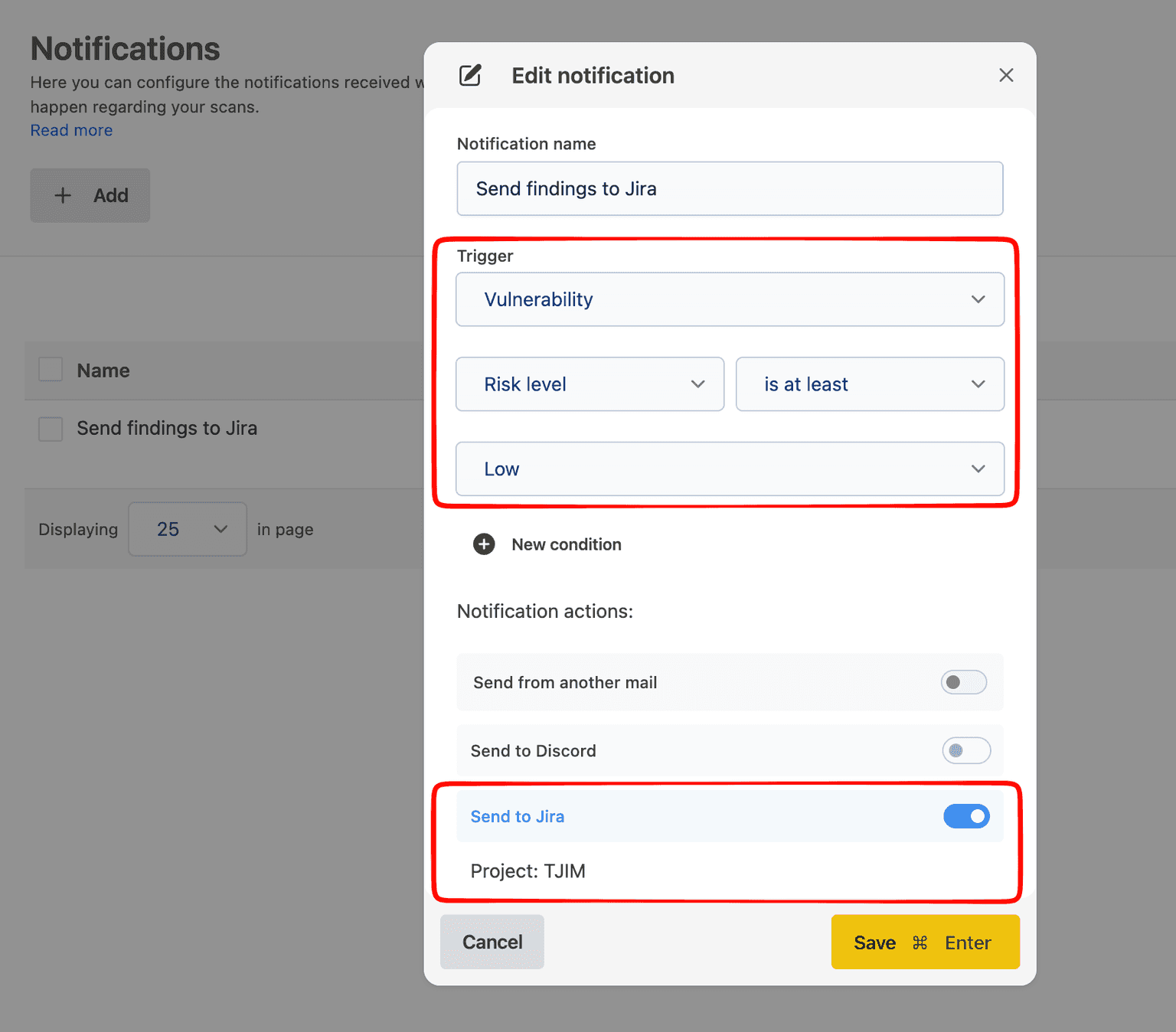
  7. Findings can now sync with Jira automatically, and each finding is sent once, so your board stays tidy.

    Jira works as a destination for Notifications, so you can use any vulnerability trigger, based on risk, the name of the vulnerability, or confidence.

    Why it matters

    Findings reach the board your team already works from, and each one arrives once.

    How to use

    Set up the Jira integration → add Jira as a destination in Notifications → choose your triggers: risk, vulnerability name, or confidence.

  8. Network Scanner now detects PHP2Shell (CVE-2026-109618 and CVE-2026-109619)

    Copy link to “Network Scanner now detects PHP2Shell (CVE-2026-109618 and CVE-2026-109619)”

    PHP released fixes for PHP2Shell (CVE-2026-109618 and CVE-2026-109619), and you can now detect it with the Network Scanner, available in your account right now. PHP versions 8.5.12, 8.4.27, 8.3.36, and 8.2.35 patch both flaws.

    How to confirm exposed or patched servers

    1. Run a scan with the Network Scanner. It identifies the PHP version each target exposes in its HTTP responses and flags versions affected by both CVEs. Every finding includes the request, the response, and the version it extracted, so you can check the evidence yourself.

    2. Start with internet-facing targets, since attackers can reach those first, then move on to internal hosts.

    3. Update to the fixed release for your branch, or apply your distro’s security update. Distributions received the patches in advance.

    4. Restart PHP-FPM or your web server, then run php -v to confirm the running version.

    5. On PHP 8.1 or older, upgrade to a supported branch. If you build from source, PHP published minimal backports for 7.4, 8.0, and 8.1.

    6. Re-scan to confirm remediation and rule out residual exposure across multiple assets.

    What to keep in mind when you read PHP2Shell results

    • Servers that hide their PHP version won’t appear as findings. Check those with php -v on the host.

    • Linux distributions often backport fixes without changing the version number. Before you escalate a finding, compare the installed package with your distro’s security advisory.

    Can’t patch today? PHP’s advisory lists temporary measures for each CVE. PHP notes that these reduce exposure to specific attack paths, but only the update closes the risk.

    Log in to scan

  9. We’re launching 6 new robots to replace the default ones

    Copy link to “We’re launching 6 new robots to replace the default ones”

    On November 3, 2026, we’re launching 6 new robots and replacing the 12 current ones, so there’s less to sort through and a clearer path from recon to proof.

    • Recon: Domain Recon Robot, Host Recon Robot, and App Recon Robot

    • Scan: Host Scan Robot and App Scan Robot

    • Scan and exploit: Host Scan and Exploit Robot

    The robots you created and your scan history stay exactly as they are. Scheduled robot scans on the old default robots keep running, but the old defaults leave the robot list and won’t get any more changes, so we recommend switching to the new robots once they launch.

    Replacement recommendations:

    • Host Scan Robot replaces Website Scanner - All Ports (scanning the top 3845 TCP ports instead of all 65,535), Website Scanner - Top 1000 Ports, The HTTP Lockpicker, Network Scanner - Full (domain), Network Scanner - Critical CVEs (domain), and Log4Shell Detector (CVE-2021-44228).

    • App Scan Robot replaces Deep WordPress Scan, Auto HTTP Login Bruteforcer, and Treasure Hunter (host).

    • Domain Recon Robot replaces Domain Recon and All Domains Recon.

    No direct replacement - Treasure Hunter (domain): to keep your scanned assets under your control, no new robot fuzzes URLs across all the subdomains of a domain. From November 3, the App Scan Robot or App Recon Robot runs the URL Fuzzer on one web app URL at a time.

    Good to know:

    • Subdomains: the new robots work on one target at a time, so they don’t scan every subdomain they discover. Each subdomain counts as its own scanned asset, so this gives you better control over which ones to scan and helps you avoid using more scanned assets than you intended. To cover subdomains, run Domain Recon Robot first, then scan the hostnames it finds.

    • Plans: which robots you see depends on your plan. For example, you see the Host Scan Robot only if your plan includes deep web scanning, because the robot runs a deep Website Scanner pass.

    Scan Robots
  10. AI Pentests, powered by Specter, is now self-serve. Pick your option on the pricing page and start whenever you need a pentest.

    It’s a one-time payment per application, with one web pentest and two retests included, so you can check your fixes. Your report arrives within 24 hours.

    We also offer a hybrid version, in which our team of certified pentesters reviews the findings and a specialist signs off the final report. It’s a good fit when your compliance work asks for pentest evidence.

    Why it matters

    Self-serve lets you start a pentest the moment you need one, and the two included retests let you check each fix.

    How to use

    Pick your option on the pricing page → start the pentest and configure it in the app → retest after you ship your fixes.

    Start a pentest

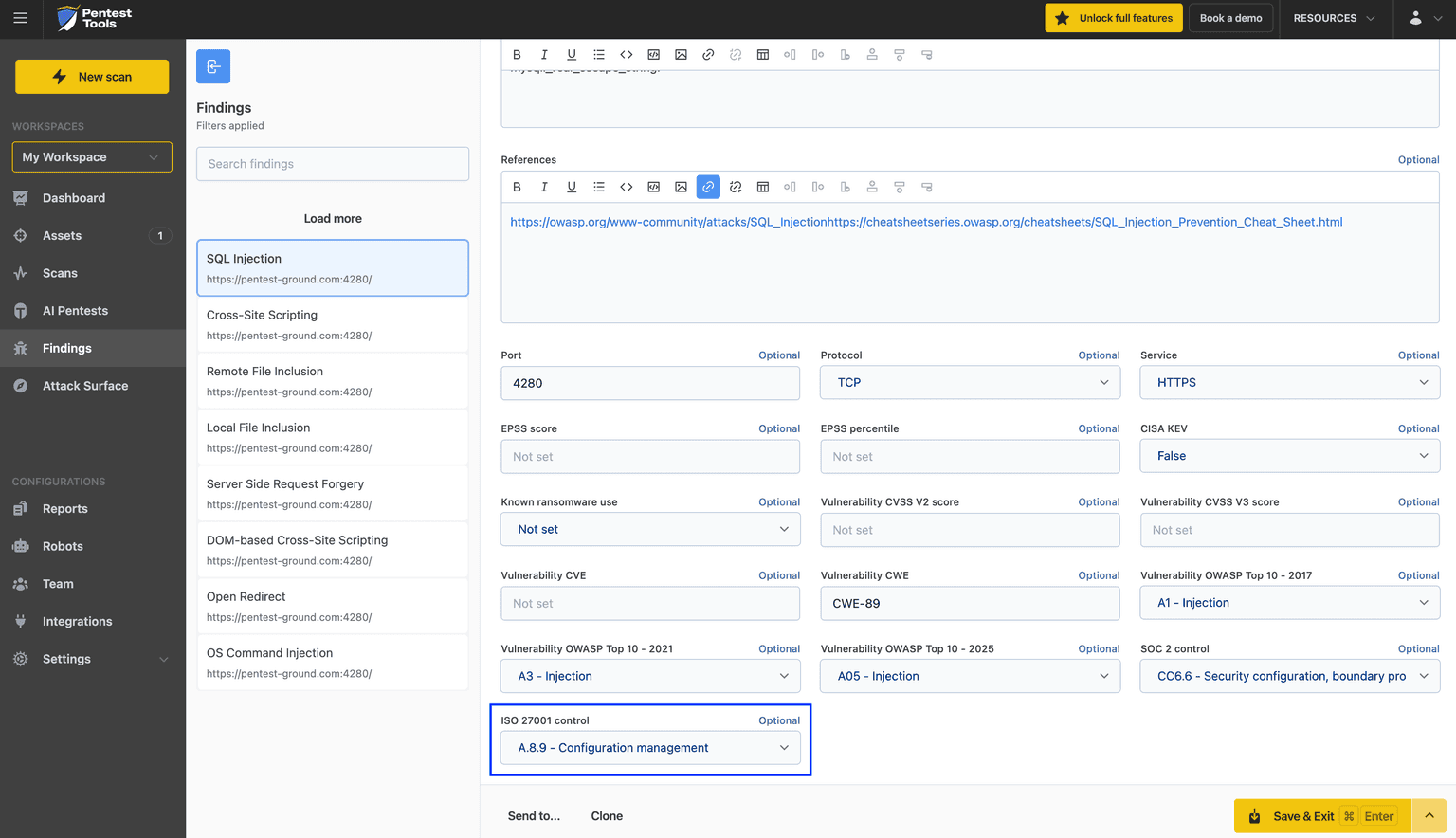
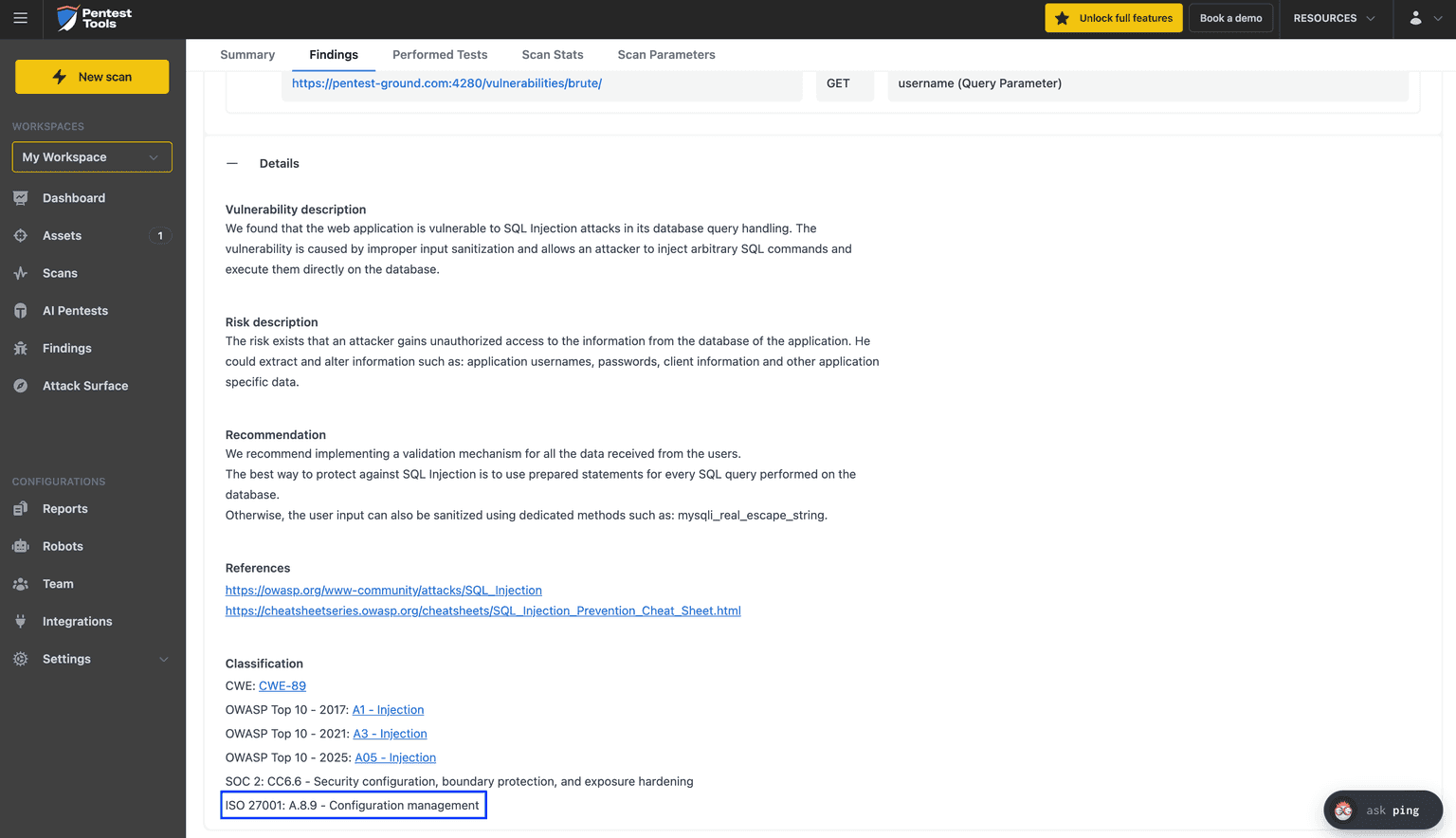
  11. Website Scanner detections now map to ISO 27001 controls

    Copy link to “Website Scanner detections now map to ISO 27001 controls”

    Website Scanner detections now map to ISO 27001 controls, following the SOC 2 mapping we added in September. If you need to line up findings with that audit, the mapping is done for you.

    Why it matters

    Matching findings to controls by hand is slow, repetitive work that sits between the scan and the audit. Doing it for you leaves more time for the part that needs your judgment.

    How to use

    See the compliance mapping

September 2026

  1. 99 new detections added to the Network Scanner

    Copy link to “99 new detections added to the Network Scanner”

    The Network Scanner gained 99 new detections in September. As always, if Sniper can exploit it, the Network Scanner can detect it.

    Three examples, each with a CVSS v3 score of 10.0:

    • unauthenticated arbitrary file read in GitLab CE/EE (CVE-2026-85706)

    • remote code execution in Ruby on Rails Active Storage (CVE-2026-66066)

    • pre-authentication remote code execution in N-able N-central (CVE-2026-86218)

    Why it matters

    Coverage that lands within days of disclosure is the difference between finding an exposure yourself and reading about it in an incident report.

    How to use

    Run a scan to check your targets, then put the high-value ones on scheduled monitoring so new coverage applies automatically as it ships.

    Scan your targets

  2. We're consolidating tools for an easier setup

    Copy link to “We're consolidating tools for an easier setup”

    From October 20, 2026, the WAF Detector, the SSL/TLS Scanner, and the Kubernetes Scanner won't be available as standalone tools in the product interface anymore.

    The WAF Detector is folding into Website Recon, so you can run the same checks without the setup spread. We'll automatically migrate scheduled WAF Detector scans to Website Recon by November 17, 2026.

    SSL/TLS Scanner and Kubernetes Scanner are folding into the Network Scanner, so the same checks run in fewer places. We'll automatically migrate the scheduled scans to the Network Scanner by November 17, 2026.

  3. From October 6, 2026, the SharePoint Scanner, the Joomla Scanner, and the Subdomain Takeover won't be available as standalone tools in the product interface anymore.

    If you're currently using these tools, we suggest replacing them with the Network Scanner for both on-demand and scheduled scans.

    Scheduled and API-triggered scans keep running until November 17, 2026.

    Your past scans and reports stay in your account.

    Run a network scan →

  4. Sniper now exploits 13 new critical vulnerabilities

    Copy link to “Sniper now exploits 13 new critical vulnerabilities”

    The biggest drop of the month includes:

    The rest cover SonicWall and SonicWall GMS, 3 Joomla-related CVEs, and a few more.

    Why it matters

    Sniper turns a detection into proof of exploitation, so the conversation with the people who own the fix starts from evidence.

    Prove it with Sniper

  5. Ping is our AI assistant that guides customers and website visitors. When something's beyond what it can handle on its own, type "I want to talk to a human." Ping now automatically creates a support ticket and hands our team the full conversation, so you get the answers you need without the hassle.